Tel: +86 15262904857 E-mail: overseas@jsbaileybridge.com
- All
- Product Name
- Product Keyword
- Product Model
- Product Summary
- Product Description
- Multi Field Search


Views: 0 Author: Site Editor Publish Time: 2026-08-01 Origin: Site


Infrastructure failures and natural disasters demand immediate action. Every hour of delayed logistics equals lost revenue. Commercial construction projects grind to a halt without reliable temporary detours. We need immediate, structural solutions to keep traffic moving. We often look to the historical legacy of the Bailey system. It saved supply lines decades ago. We must pivot to a modern engineering evaluation today. While the classic bailey bridge remains a global standard for modular deployment, modern alternatives offer varying trade-offs. They differ heavily in load capacity, assembly speed, and equipment requirements. You will learn how these structural systems compare across vital performance metrics. We will explore complex logistics, span capabilities, and necessary site preparations. You will discover exactly which temporary bridging solution fits your specific project needs.
Labor vs. Machinery: Bailey bridges excel in environments lacking heavy lifting equipment, utilizing a cantilever launching method, whereas pre-fabricated beam bridges require large cranes.
Material Efficiency: Modern proprietary panel bridges (e.g., Mabey, Acrow) offer higher load capacities with fewer components compared to standard Bailey designs.
Site Flexibility: The modularity of a steel Bailey bridge allows for on-the-fly span adjustments, unlike fixed-length temporary spans.
Decision Driver: Final selection hinges on site accessibility, required load classes (e.g., AASHTO HS20), and timeline urgency.
Before comparing systems, you must define project constraints. We measure engineering success through specific, quantifiable metrics. Site variables dictate which structure performs best. You cannot simply guess load requirements.
Load and Traffic Volume: Standard commercial traffic needs differ greatly from heavy industrial transport. Pedestrian use requires less rigorous bearing capacity. Heavy haul trucks demand higher AASHTO ratings. You must calculate the maximum axle load. Dynamic impact factors also play a critical role. High-frequency traffic stresses temporary joints much faster than occasional vehicle crossings.
Span Dynamics: You must assess unsupported span limits carefully. Short spans behave differently than extended river crossings. Intermediate piers become necessary for extended reaches. Deflection tolerances dictate how much a deck can bend. You must ensure the structure remains rigid under maximum capacity.
Geotechnical & Access Constraints: Evaluate soil bearing capacity immediately. Abutments require solid, unyielding ground. Standard Penetration Tests (SPT) help confirm soil stability. Transport restrictions dictate allowable component sizes. Remote sites often reject massive flatbed deliveries. Sharp switchbacks prevent long beam transportation.
Temporary Bridge Success Metrics Chart
Evaluation Metric | Primary Consideration | Impact on Bridge Selection |
|---|---|---|
Axle Load Rating | AASHTO HS20 or standard pedestrian | Determines required truss density |
Unsupported Span | Distance between stable banks | Dictates structural system limits |
Delivery Access | Road width and turning radii | Rules out large prefabricated beams |
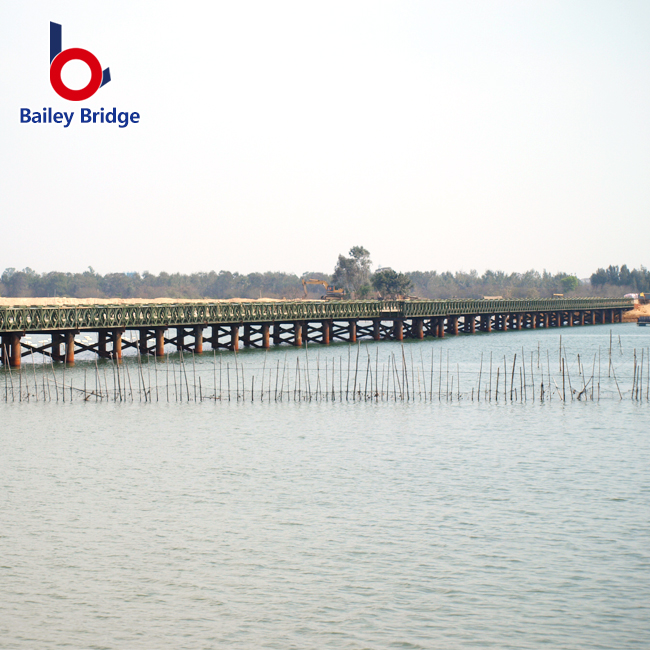
The classic steel bailey bridge establishes our engineering baseline. It relies on brilliant simplicity. Global construction teams trust this standardized system. It resolves complex logistical nightmares easily.
Standardized Modularity: The pin-jointed truss system uses standard 10-foot (3-meter) panels. You can swap components easily between projects. Crews use transoms, sway braces, and rakers to connect panels. This modularity ensures parts remain universally compatible.
Machinery-Free Erection: The cantilever launching process requires no large cranes. Crews use a launching nose and specialized rollers. Human labor pushes the structure slowly across the gap. This proves crucial for remote or obstructed sites. It saves projects when heavy machinery cannot reach the location.
Scalability: You can add reinforcing chords dynamically. Truss configurations increase shear and bending capacity. You might upgrade a Single-Single setup to a Double-Single configuration. Engineers adapt the bridge capacity directly on site.
Best Practice: Always inventory your modular pins before starting assembly. Missing shear pins halt manual launches immediately.
Modern engineering has improved upon the classic modular concept. Proprietary systems like Acrow or Mabey dominate highway detours today. We must examine how they contrast with traditional setups.
Modern proprietary systems utilize high-yield tensile steel. This material allows panels to carry heavier loads. Traditional systems often rely on standard mild steel. High-yield steel reduces the overall weight of the structure. It offers superior strength-to-weight ratios.
Decking materials also reveal stark differences. Traditional setups frequently use timber planks or basic steel plates. Timber rots and plates grow slick under rain. Modern panel bridges feature orthotropic steel decks. These specialized decks distribute wheel loads across a wider area. They offer superior fatigue resistance. Crews install them much faster than laying individual timber planks.
Granularity defines the traditional system. It requires hundreds of small pins, bolts, and braces. Modern panel bridges utilize fewer components. They rely on larger structural pins. They also feature longer baseline sections. This design reduces overall labor hours significantly.
Fewer connections mean faster assembly. A modern proprietary bridge requires less granular labor. However, these larger components weigh more. You often need small cranes to position modern panels. The traditional system remains superior for pure manual lifting.
Prefabricated beam bridges offer a vastly different deployment strategy. They arrive pre-assembled or in massive sections. We must compare their logistical realities against modular trusses.
Beam bridges require massive flatbed transport. Highway access must remain unobstructed. Tight mountain roads easily block flatbed deliveries. Beam structures also demand heavy cranes for placement. You cannot push a concrete beam across a gap manually.
Modular truss components fit onto standard commercial trucks. You can transport them in smaller batches. Crews can manually offload panels if forklifts fail. This logistical flexibility makes modular designs perfect for disaster zones. You avoid the nightmare of transporting oversized loads.
Beam bridges dominate short spans. They remain highly efficient for crossings under 40 feet. Construction teams drop them into place quickly. However, they become logistically impossible for long unsupported crossings. A 150-foot beam cannot easily navigate public roads.
Truss systems thrive across wide gaps. Their structural depth allows them to span long distances safely. You can link panels indefinitely over intermediate piers. Modular designs defeat beam bridges entirely when span requirements exceed standard trucking limits.
Water crossings present unique challenges. Engineers sometimes choose floating bridges over fixed structures. We must evaluate how truss bridges compare to pontoon systems.
Floating bridges require highly manageable water currents. Fast rivers easily sweep pontoons away. They also require gentle bank slopes for vehicle access. Hydrodynamic drag constantly threatens floating piers. Debris strikes can puncture buoyancy cells.
Truss bridges bypass water conditions entirely. They span safely above the flood line. They rely purely on engineered bank abutments. You do not worry about rising water levels. The truss remains immune to seasonal river fluctuations.
Steel trusses offer rigid structural predictability. You know exactly how much the deck will deflect. Floating bridges suffer dynamic load shifting. Heavy trucks create localized depressions in the water. The deck rolls and pitches as vehicles cross.
This buoyancy dependence limits speed. Traffic must crawl across pontoon bridges. Fixed modular bridges allow normal traffic flow. They provide a stable, concrete-like driving experience.
Temporary structures demand rigorous oversight. You cannot treat them as casual installations. We must mitigate risks during assembly and active use.
Labor Competency: Manual pin-joint assemblies invite human error. Crews might overlook a missing sway brace. They might install panels backward. Strict adherence to engineering diagrams is mandatory. Site supervisors must verify every single connection. A single missing shear pin compromises the entire truss.
Site Preparation: Temporary definitely does not mean zero prep. You need perfectly level launching areas. The ground must support the rollers during cantilever pushes. Crews must install engineered bearing plates at the abutments. These plates distribute massive loads into the soil. Skipping soil compaction leads to immediate abutment failure.
Inspection and Compliance: Maintenance does not end after installation. You must conduct regular torque checks. Bolts vibrate loose under dynamic traffic. Inspectors must perform visual checks of all shear pins. High-frequency traffic induces metal fatigue. You should establish a weekly compliance checklist.
Common Mistake: Never ignore bank erosion. Heavy rains wash away abutment soil fast. Always install riprap or retaining walls around temporary foundations.
Selecting the right structure requires objective analysis. You must match bridge capabilities to project constraints. We can categorize the ideal use cases clearly.
When to choose a Steel Bailey Bridge: Select this system for remote access locations. It dominates when span requirements remain unpredictable. It wins when you lack heavy cranes. Available manual labor drives this choice. Disaster relief agencies rely on it exclusively for these reasons.
When to choose Modern Panel Bridges: Choose these for high-budget highway detours. They handle extreme heavy-load requirements perfectly. They serve well for long-term, semi-permanent use. Highway departments prefer their fast assembly and orthotropic decking.
When to choose Prefab Beam Bridges: Opt for beams on short spans. They work best with easy highway access. You need abundant heavy machinery already on-site. They excel in standard commercial subdivisions.
Deployment Scenario Comparison
Bridge Type | Primary Advantage | Ideal Environment | Crane Requirement |
|---|---|---|---|
Standard Modular Truss | Extreme logistical flexibility | Remote, disaster-struck areas | None (Manual launch possible) |
Proprietary Panel (Acrow) | High fatigue resistance | Major highway detours | Light to Medium Cranes |
Prefabricated Beam | Instant placement for short spans | Accessible commercial zones | Heavy Duty Cranes |
The classic modular truss is far from obsolete. It remains highly specialized for extreme logistical flexibility. It completely dominates equipment-scarce environments. While modern proprietary panels offer faster decking and higher yield strength, they demand better site access. Prefabricated beams and floating pontoons serve very narrow, specific use cases. You must base your final decision on actual site realities rather than assumptions.
Advise stakeholders to conduct formal geotechnical site surveys immediately. You must consult with licensed structural engineers. They should run thorough load-simulation models before you procure any materials. Secure your abutments, verify your transport routes, and choose the system that guarantees safe, continuous traffic flow.
A: Configuration limits dictate maximum lengths. They typically span up to 200 feet (60 meters) unsupported. The exact span depends entirely on the required load capacity and truss configuration. Heavier loads require double or triple truss reinforcements, which slightly reduces the maximum unsupported reach due to self-weight.
A: You do not strictly need specialized equipment. Crews often utilize a manual cantilever launching process. They assemble sections on rollers and push the structure across the gap. However, utilizing a crane significantly speeds up assembly if the site allows for heavy machinery access.
A: Though frequently misspelled as 'baily bridges,' the standard Bailey bridge adheres to the exact same modular truss engineering principles globally. There is no structural difference. Both terms refer to the identical pin-jointed, modular steel bridge system designed for rapid deployment in temporary or emergency scenarios.
A: Yes, they can serve as permanent structures. You must strictly manage maintenance requirements. Long-term use requires proper galvanization to prevent corrosion. Engineers must also monitor fatigue limits under continuous, dynamic traffic loads. Upgrading decking and performing regular shear pin inspections ensure structural integrity over decades.
