Tel: +86 15262904857 E-mail: overseas@jsbaileybridge.com
- All
- Product Name
- Product Keyword
- Product Model
- Product Summary
- Product Description
- Multi Field Search


Views: 0 Author: Site Editor Publish Time: 2026-09-28 Origin: Site


Selecting temporary infrastructure involves high stakes. Project delays, budget overruns, and safety liabilities often hinge on choosing the right bridge design. You must get this decision right. Traditional options include bespoke timber spans, floating pontoons, and heavy folding bridges. They often lack standardized engineering. They can cause unpredictable timelines and severe logistical headaches.
This guide provides an evidence-based comparison. We help procurement teams and engineers evaluate features against real-world outcomes. You will learn how to make a compliant, cost-effective decision. We explore structural advantages, rapid logistics, and asset reusability. You will discover exactly why modular infrastructure outperforms traditional temporary builds.
Predictable Timelines: Modular, pre-engineered components drastically reduce installation time and require minimal heavy lifting equipment.
Superior Load Profiles: High-tensile steel construction allows for heavy commercial and construction plant traffic, outperforming timber and pontoon alternatives.
Logistical Efficiency: Standardized parts fit into standard shipping containers, driving down freight costs and enabling delivery to remote sites.
High ROI / Reusability: Asset longevity allows the bridge to be disassembled, stored, and redeployed across multiple projects, significantly lowering total cost of ownership.
You must clearly define the criteria for a successful temporary bridge before you begin procurement. Every project faces unique constraints. Speed of deployment is usually the top priority. Site accessibility often dictates what materials you can deliver. Load requirements dictate the structural strength you need. Budget constraints ultimately govern the final choice.
Engineers generally choose from four distinct solution categories. Each category presents specific benefits and severe limitations. Pontoons deploy quickly over water. However, water conditions heavily limit their use. They struggle in strong currents. They require a specific draft. They also offer much lower load-bearing capacities compared to fixed structures.
Custom timber or steel bridges offer high customizability. You can design them for specific topographies. Yet, they suffer from highly unpredictable lead times. They require specialized fabrication labor. Once the project ends, they offer almost zero reusability. Heavy folding bridges present another alternative. Military armored vehicle-launched bridges provide instant deployment. But they carry extremely high procurement costs. They also suffer from severe span length limitations.
A standardized bailey bridge occupies the ideal middle ground. It offers rapid modular deployment. It also delivers the permanent-bridge load capabilities you expect from fixed infrastructure. You gain speed without sacrificing structural safety.
Bridge Category Comparison Chart
Bridge Category | Deployment Speed | Load Capacity | Reusability |
|---|---|---|---|
Pontoon Bridges | Fast | Low to Medium | High (Water only) |
Custom Timber/Steel | Slow | Medium to High | Zero to Low |
Heavy Folding Bridges | Instant | High | High |
Standardized Modular | Fast | Very High | High (Any terrain) |
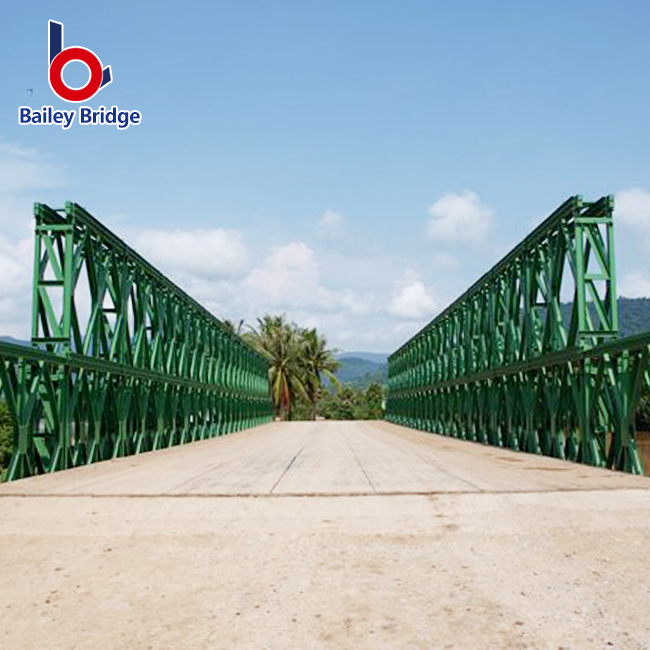
Standardized inventory completely changes the project timeline. Pre-fabricated, interchangeable panels eliminate custom fabrication delays. You do not wait weeks for a steel mill to cut specific girders. Manufacturers keep these standard components in stock. You can order them and ship them immediately. This plug-and-play approach keeps your project strictly on schedule.
Assembly requires surprisingly light equipment. The cantilever launching method is a major engineering advantage. You assemble the structure on one bank. You attach a lightweight launching nose to the front. You place the structure on specially designed rollers. You then push it across the gap. You do not require heavy cranes positioned in the water. This protects local waterways and reduces equipment rental fees.
Here are the typical stages of a cantilever launch:
Install the landing rollers on both the near and far banks.
Assemble the lightweight launching nose on the near bank.
Connect the main structural panels behind the launching nose.
Push the entire assembly forward over the gap using machinery or winches.
Remove the launching nose once it reaches the far bank rollers.
Scalable spans give engineers incredible flexibility. You can incrementally increase the span length. You can also increase the overall load capacity. You might start with a single-single configuration for light traffic. If project demands change, you easily upgrade it. You simply add more standard panels to create a double-double configuration. You achieve greater strength without buying a brand-new system.
Material specifications matter immensely in temporary infrastructure. A modern steel bailey bridge relies on high-yield, high-tensile steel. This premium material endures massive dynamic loads. Moving vehicles create kinetic forces. Heavy braking creates horizontal stress. High-tensile steel absorbs these forces safely. It also withstands severe weather conditions, from freezing temperatures to intense tropical heat.
Heavy machinery support drives commercial outcomes. Logging operations, mining sites, and disaster relief zones depend on heavy equipment. Pontoons and light aluminum variants often fail under these extreme weights. A properly configured steel structure easily supports 40-ton dump trucks. It handles massive excavators. It routinely carries heavy military convoys. You avoid bottlenecks because your heavy plant machinery can cross without restrictions.
Compliance and safety protocols protect your operations from liability. Modern modular variants adhere to strict international bridge codes. Engineers design them to meet AASHTO standards in North America. They also comply with Eurocode regulations in Europe. These certifications provide verifiable safety data. You can present these load calculations to local authorities. This mitigates operational risk and speeds up the permitting process.
Freight and access directly impact your project budget. Traditional bridge girders require massive, specialized transport trucks. Modular systems break down into highly manageable components. You can transport these parts using standard commercial trucks. You can pack them tightly into standard shipping containers. This allows delivery to highly remote locations. You can navigate constrained topographies and tight mountain roads.
Upfront costs only tell a fraction of the story. You must evaluate the overall lifecycle value. Custom bridges become scrap metal after one use. Standardized modular components are completely reusable. You dismantle them when the project finishes. You store them in a standard yard. You then redeploy them for your next major project. This continuous reusability slashes long-term capital expenditures across your portfolio.
The maintenance profile is exceptionally minimal. You do not need expensive specialized teams to keep it safe. Maintenance primarily involves routine visual inspections. You check the panel pins and tighten bolts periodically. You also inspect the anti-corrosion coatings. Most modern components feature hot-dip galvanization. This zinc coating prevents rust and extends the lifespan for decades.
We must maintain absolute trustworthiness regarding implementation. The superstructure builds rapidly. However, foundation requirements remain strict. You cannot simply drop the panels onto soft mud. The system requires solid, engineered abutments. You must build proper bank seats. This prevents the heavy steel structure from settling unevenly into the earth. Poor foundations will compromise the strongest steel.
Deflection under load is a known engineering reality. These modular systems can experience more deflection than permanent concrete bridges. Drivers might notice a slight bounce as heavy trucks cross. This is normal and structurally safe. You can manage this deflection easily. You enforce strict vehicle speed limits. You can also specify heavier panel configurations to stiffen the overall span.
Labor familiarity prevents costly accidents. Assembly looks straightforward on paper. The pin-and-hole system is intuitive. Yet, it still requires an experienced supervisor. A trained professional ensures proper pin placement. They enforce critical launching safety protocols. They understand how to balance the counterweight during the push. You must never attempt a cantilever launch without experienced oversight.
You need a precise evaluation checklist before contacting a manufacturer. Gathering accurate data saves weeks of back-and-forth communication. You must know your exact site parameters.
What is the required clear span from bank seat to bank seat?
What is the heaviest single vehicle load you anticipate? (e.g., an HL-93 design load).
What is the total project duration?
Do you need pedestrian walkways attached to the side?
Answering these questions clarifies your financial strategy. Short-term projects often benefit from a rental agreement. Multi-year projects justify a capital purchase.
Your shortlisting next steps require fieldwork. Advise your survey team to gather precise site topography data. You must also commission detailed soil reports. Manufacturers need this soil data to calculate bank seat dimensions. Once you have this data, you can engage a manufacturer. They will produce a specific configuration drawing tailored exactly to your site.
Modular steel systems remain the undisputed industry standard for temporary crossings. They completely remove the guesswork from temporary infrastructure planning. They offer a verifiable, engineered balance of speed, absolute strength, and lifecycle cost-efficiency.
You no longer have to choose between a fast deployment and a safe load capacity. Standardized panels give you both simultaneously. Your next step should focus on hard data. Consult a licensed structural engineer regarding your soil conditions. Contact a certified manufacturer today to request a specific load-capacity calculation for your exact clear span.
A: The maximum unsupported span depends entirely on the panel configuration. Standard configurations typically reach up to 60 meters (roughly 200 feet) unsupported. If you need to cross a wider gap, you must install intermediate piers to support the joined spans safely.
A: No, they are exactly the same. The term baily bridges is simply a common misspelling of the original Donald Bailey design. Both terms refer to the exact same modular, pre-fabricated steel panel structure used globally for rapid deployment.
A: Yes. Many are initially installed for emergency relief but remain in place for decades. With proper steel decking, regular inspections, and routine anti-corrosion maintenance, they function perfectly as permanent infrastructure in rural and developing regions.
A: No. The system utilizes a cantilever launching method. You build a launching nose and push the structure across the gap using rollers. While cranes can speed up the assembly of individual panels, they are not strictly mandatory for the final launch.
