Tel: +86 15262904857 E-mail: overseas@jsbaileybridge.com
- All
- Product Name
- Product Keyword
- Product Model
- Product Summary
- Product Description
- Multi Field Search


Views: 0 Author: Site Editor Publish Time: 2026-10-02 Origin: Site


Procuring heavy infrastructure rarely resembles shopping from a retail catalog. Planners and engineers quickly discover an uncomfortable truth when pricing civil structures. There is no single, fixed price tag for a reliable truss bridge. Costs fluctuate wildly based on specific load requirements, varying span lengths, and unpredictable site conditions. You cannot simply guess a budget based on generic historical averages without risking massive financial overruns.
This guide gives project managers, engineers, and municipal planners a transparent, evidence-based estimating framework. We will explore how structural materials, site preparation, and freight logistics interact to drive your final project budget. You will learn how to anticipate hidden expenses, evaluate modular structural options, and ultimately secure an accurate commercial or pedestrian infrastructure estimate. Our goal is to help you confidently navigate the procurement process from initial planning to final site installation while preventing surprise costs.
Cost vs. Span: The cost per square foot typically decreases as the span increases, though total project costs will scale with structural complexity.
Material Impact: Material choice (Steel, Wood, FRP) dramatically alters both initial CapEx and long-term OpEx.
Modular Efficiencies: Pre-engineered systems, such as a bailey truss bridge, can significantly reduce on-site labor and installation timelines.
Hidden Variables: Freight, abutment engineering, and environmental permitting often account for up to 30-40% of the total project budget.
Span length profoundly impacts your total structural cost. However, the relationship between length and price is completely non-linear. A 100-foot span does not simply cost twice as much as a 50-foot span. Longer spans require much deeper trusses. They demand thicker, heavier steel members to prevent deflection. This added structural mass shifts your cost curve upward. Width also dictates pricing. Expanding a single-lane structure to a dual-lane configuration increases the dead load. The design must incorporate heavier floor beams and enhanced lateral bracing to support this extra width.
You must clearly define your structural load requirements before requesting quotes. Load capacity strictly dictates how much raw material goes into fabrication. Pedestrian or light-duty trail bridges require far less structural mass. They typically support standard pedestrian uniform loads, such as 90 pounds per square foot. Vehicular bridges operate under entirely different engineering constraints. Highway projects must meet rigorous AASHTO load ratings, such as HL-93. These heavy-duty requirements demand robust steel profiles, reinforced decking systems, and extensive fatigue analysis. Naturally, vehicular structures command a much higher price point.
Site conditions can quickly ruin a well-planned budget. The soil stability directly dictates your foundation costs. A highly affordable superstructure easily becomes expensive if your site requires complex deep piling. Engineers must anchor the abutments securely into stable earth or bedrock.
Soil Bearing Capacity: Soft, marshy soils require driven piles or drilled shafts. Firm bedrock allows for cheaper, shallow spread footings.
Water Flow and Scour: Bridging an active waterway requires scour protection. You must armor the abutments against rushing water, driving up site preparation costs.
Elevation Changes: Uneven banks force engineers to design asymmetric abutments. Custom concrete forms increase local labor and material expenses.
Prefabricated steel remains the absolute industry standard. It delivers unmatched durability and exceptional load capacity. Planners typically choose between two primary finishes: weathering steel and hot-dip galvanized steel. Weathering steel (often known as Corten) develops a protective rust-like patina. This outer layer seals the steel against further atmospheric corrosion. Galvanized steel receives a protective zinc coating. Steel structures carry a higher upfront capital expense. However, their incredible longevity and low-maintenance profiles offer massive lifecycle advantages. You avoid costly painting cycles and structural rot repairs over the coming decades.
Fiber Reinforced Polymer offers a brilliant alternative for highly corrosive environments. Planners frequently evaluate FRP for pedestrian crossings in coastal zones or chemical plants. FRP materials completely resist saltwater, de-icing chemicals, and biological decay. This material does carry a higher initial purchase price than standard wood or basic steel. Yet, FRP is incredibly lightweight. This drastically lowers freight fees and allows for smaller installation equipment. You easily offset the higher initial material cost through zero-rot, zero-rust lifecycle benefits.
Timber structures remain popular for nature parks, golf courses, and rustic hiking trails. Wood offers an aesthetically pleasing, natural appearance. It often presents the lowest initial capital expense among modern bridge materials. However, buyers should approach timber with healthy skepticism regarding long-term operating costs. Wood inevitably falls victim to biological decay, moisture intrusion, and insect damage. You must budget for continuous ongoing maintenance. Expect to apply costly sealants routinely and replace rotting deck boards. Ultimately, a timber bridge provides a significantly lower lifespan compared to steel or FRP alternatives.
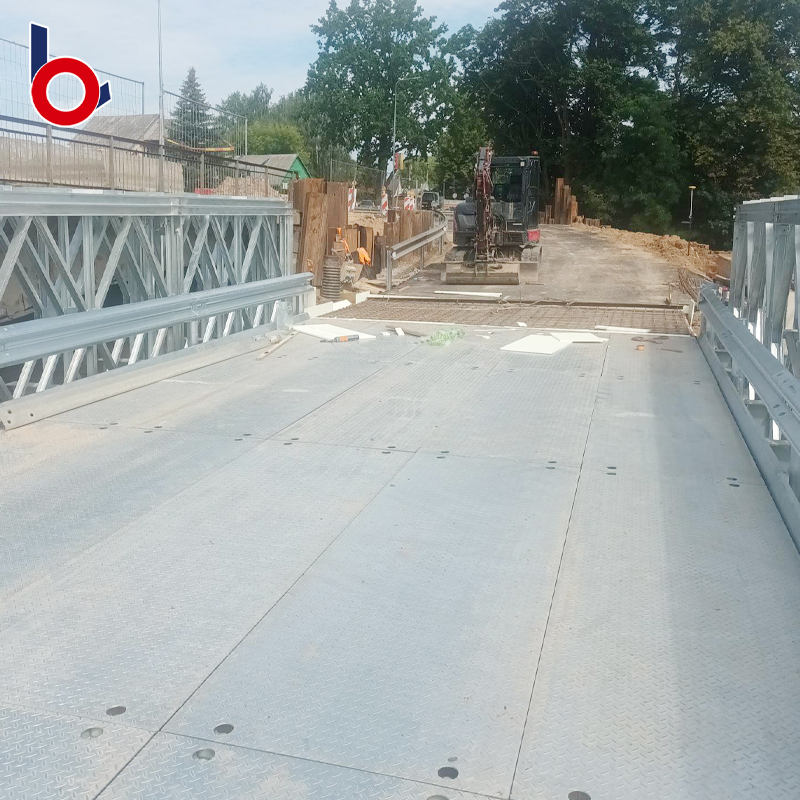
A bailey truss bridge acts as a highly versatile, pre-engineered structural solution. Originally developed for rapid military deployment, modern iterations serve commercial and municipal needs perfectly. Manufacturers build these systems using standardized, interchangeable steel panels. The modular design makes the structure portable, scalable, and remarkably easy to assemble on-site.
These modular systems strip immense waste from the traditional procurement process. Because the components are standardized, you eliminate lengthy custom engineering timelines. Fabricators mass-produce the interchangeable parts and keep them in inventory. This economy of scale drives down the per-unit fabrication cost. You buy a proven, off-the-shelf structural system rather than funding expensive bespoke design work.
Modular bridges prove highly cost-effective in several distinct scenarios. Planners should evaluate this system when speed and adaptability are paramount project goals.
Temporary Construction Access: Heavy equipment can cross rivers without waiting months for a permanent structure.
Disaster Relief Operations: Emergency crews can replace washed-out rural spans in a matter of days.
Fast-Tracked Infrastructure: Municipalities can upgrade failing timber structures quickly while minimizing local road closures.
Installation costs often make or break an infrastructure budget. Modular truss systems drastically reduce field labor expenses. Teams frequently employ a clever launch-and-roll installation method. Workers assemble the structure on rollers on one side of the gap. They then push the entire bridge across the span using a cantilever nose. This ingenious method completely minimizes the need for massive heavy-lift cranes. You avoid exorbitant daily crane rental fees and significantly drop your total site-labor costs.
Bridge components qualify as oversized loads. Shipping these massive steel sections requires specialized logistical planning. Freight fees consume a surprisingly large portion of the total budget. Proximity to the fabrication facility matters greatly. Shipping a structure three states away adds thousands of dollars. Furthermore, site accessibility heavily impacts delivery fees. Navigating heavy flatbed trucks down narrow, winding, or unpaved rural roads requires pilot cars and complex staging logistics.
Buyers face a critical choice between fully assembled delivery and knocked-down delivery. A fully assembled bridge minimizes on-site work. A crane simply lifts it off the truck and sets it onto the abutments. However, shipping a fully assembled truss commands premium oversized freight rates. Conversely, a knocked-down delivery ships unassembled on standard trailers. This slashes your freight bill but increases your field labor. Construction crews must spend days bolting the structural members together on-site. You must carefully calculate which method yields the lowest combined cost for your specific location.
Regulatory compliance introduces subtle financial impacts. Failing to anticipate permitting costs delays projects and triggers budget overruns. If your pedestrian bridge requires ADA compliance, you must adhere to strict slope requirements. You may need to build extensive approach ramps, consuming more land and materials. Environmental impact studies also drain budgets, especially when bridging sensitive wetlands or salmon-bearing streams. Local municipalities may also demand specific engineering seal requirements, forcing you to hire regional consultants to review the manufacturer's plans.
Trusses excel in specific structural scenarios. They remain the ideal choice for clear spans extending over 40 feet where intermediate piers are impossible or prohibitively expensive. If you must cross an active, navigable waterway, a deep rocky ravine, or a major highway, trusses deliver exceptional value. They carry heavy loads across long distances using incredibly efficient material distribution.
You should evaluate commercial boardwalk systems when traversing sensitive wetlands or marshy terrain. Boardwalks feature a low profile and utilize multiple intermediate foundation supports. If your environmental permits allow driving small piles into the mud every 15 feet, a boardwalk makes sense. In these specific, low-clearance scenarios, a commercial boardwalk system often yields a lower total installed cost than a single, massive long-span truss.
Engineers frequently compare trusses against traditional rolled I-beam bridges. Beam bridges utilize simple, heavy steel girders. For very short vehicular spans (under 40 feet), beam bridges often cost less. They require minimal fabrication time. However, as the span grows longer, solid beams become incredibly heavy and highly inefficient. For longer clear spans, trusses easily win on material efficiency. The open-web design reduces dead weight while providing superior stiffness and far better architectural aesthetics.
Bridge Type | Ideal Span Range | Best Structural Use Case | Relative Material Efficiency |
|---|---|---|---|
Truss Architecture | 40 to 250+ feet | Deep ravines, clear waterways, no intermediate piers allowed. | Highly efficient over long distances. |
Commercial Boardwalk | Continuous (Short Spans) | Wetlands, marshes, parks requiring low profiles. | Relatively low per span, requires many supports. |
I-Beam Structure | 10 to 40 feet | Short vehicular crossings, simple highway overpasses. | Inefficient and overly heavy for long clear spans. |
Calculating an accurate infrastructure budget requires careful analysis of multiple intersecting variables. You must aggressively balance your initial material choices against site-specific installation constraints. A cheap wooden structure might save capital today, but aggressive maintenance routines will quickly drain your operating budget. Buyers must look beyond the basic price of the superstructure alone. You should exclusively focus on calculating the true, final "installed cost" of the project.
To ensure project success, define your parameters clearly. Identify your maximum load capacity, exact crossing width, and required clear span length. Invest early in a proper geotechnical soil report. Armed with this hard data, we encourage you to contact an experienced engineering team. Submit your specific parameters to request a comprehensive, site-specific, and verifiable quote today.
A: Custom designs typically require 12 to 16 weeks for detailed engineering and heavy fabrication. Conversely, pre-engineered modular options often ship in just a few weeks. Site assembly times vary wildly. A fully assembled pedestrian structure might require only one day to set. Unassembled vehicular crossings often demand several weeks of careful field bolting and extensive abutment preparation.
A: Yes, prefabricated options generally cost significantly less. Manufacturers leverage deep economies of scale by producing standardized, interchangeable structural components. This streamlined process eliminates bespoke engineering fees and reduces expensive custom fabrication hours. Buyers receive a proven, reliable structure without paying an exorbitant premium for one-off design work.
A: A properly maintained steel structure easily boasts a standard design life ranging from 75 to over 100 years. Environmental conditions and protective coatings strictly dictate longevity. Utilizing weathering steel or hot-dip galvanized finishes dramatically extends this lifespan by actively preventing structural corrosion. Routine inspections ensure the bridge remains entirely safe and functional for generations.
