Tel: +86 15262904857 E-mail: overseas@jsbaileybridge.com
- All
- Product Name
- Product Keyword
- Product Model
- Product Summary
- Product Description
- Multi Field Search


Views: 0 Author: Site Editor Publish Time: 2026-07-13 Origin: Site


Securing rapid, reliable river crossings for high-tonnage vehicles presents a formidable infrastructure challenge. Remote operations rely on moving massive logging trucks, heavy military convoys, and oversized mining equipment across wide, unforgiving gaps. Standard temporary structures often buckle under these extreme demands. They simply lack the sheer capacity required for continuous, heavy, repetitive axle loads.
Here, the Compact 200 (C200) Bailey Bridge emerges as the proven industry standard. Engineers designed this robust modular upgrade specifically to handle wider vehicle lanes and immense sheer stress. It decisively solves the bottlenecks found in legacy bridging systems.
This guide gives project managers and procurement professionals a clear, evidence-based framework. We help you evaluate, specify, and source the right modular system effectively. You will learn how to navigate span-to-load limits, procurement risks, and complex installation logistics. Ultimately, this approach ensures you secure dependable heavy vehicle access. You achieve this without over-engineering your site or ever compromising operational safety.
Load Readiness: The Compact 200 increases sheer capacity significantly over legacy models, accommodating heavy-duty axle loads standard in commercial and industrial operations.
Specification Constraints: Selection depends heavily on standardizing span lengths against required load classes (e.g., AASHTO HS20/HS25 or Eurocode standards).
Cost vs. Risk: While used components offer upfront savings, verifying fatigue life and corrosion history via Non-Destructive Testing (NDT) is non-negotiable for heavy vehicle access.
Implementation Efficiency: A prefabricated Bailey bridge minimizes site preparation, utilizing standardized cantilever launching methods that require minimal heavy lifting equipment.
Identify scenarios where standard temporary structures fundamentally fail. Many infrastructure managers quickly spot inadequate lane widths for enormous off-highway trucks. They also witness insufficient sheer capacity when continuous heavy repetitive loads cross daily. When standard timber mats or generic scaffolding bridges show fatigue, operations risk catastrophic failure. You must evaluate your site needs honestly.
Defining the "heavy duty" threshold triggers a mandatory C200 upgrade. You must determine your exact target gross vehicle weights. An articulated dump truck fully loaded with wet ore weighs vastly more than a standard highway lorry. Calculate the exact daily frequency of these crossings. Fatigue scales exponentially with frequency. Establish your desired lane widths precisely. A Compact 200 Bailey Bridge handles these demanding physical thresholds effortlessly. It prevents costly logistical bottlenecks.
People commonly view these structures purely as emergency or temporary access roads. However, galvanized C200 structures frequently serve incredibly well as permanent solutions. When you maintain them correctly, they defy their temporary label. They transition seamlessly from disaster relief installations to long-term community or industrial infrastructure. You save massive capital by retaining a robust crossing indefinitely rather than building a concrete alternative.
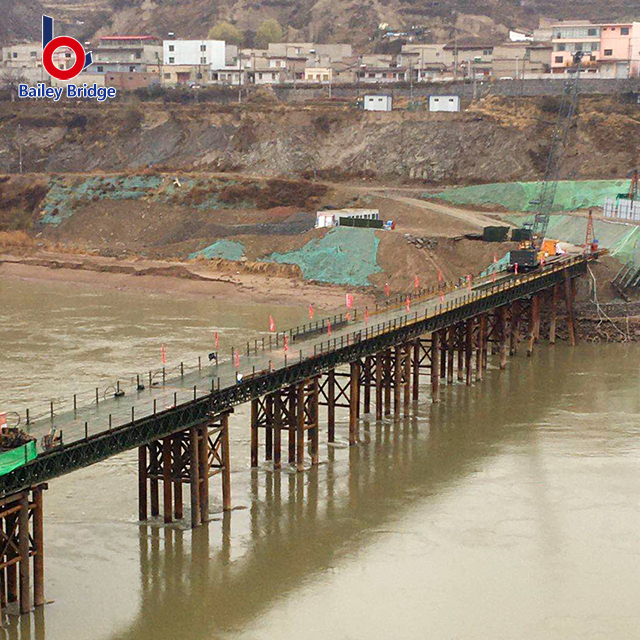
The C200 introduces specific dimensional increases over the legacy C100 system. The most crucial change happens in panel height. C100 panels stand at 1.524 meters tall. The C200 elevates this to 2.134 meters. This extra vertical height fundamentally alters the structural layout. It drastically improves the overall load-bearing characteristics. Greater panel depth creates a higher moment of inertia, resisting heavy loads naturally.
Sheer strength and stiffness see massive, engineered improvements. Heavy multi-axle vehicles generate immense shear forces. This happens violently during heavy braking and sudden accelerating. The deeper panels and thicker steel chords in the C200 reinforce the entire structure against these specific dynamic loads. They prevent dangerous downward deflection and lateral sway.
Standard lane width accommodations also change favorably. The updated design supports significantly wider commercial vehicles. C100 standard widths restrict large machinery. The C200 supports wider standard configurations and extra-wide lane options. You fit massive loaders and wide-track excavators easily. You achieve this without demanding complex or custom structural modifications.
We offer a simple evaluation heuristic for buyers. Review your vehicle fleet carefully. If your daily traffic includes articulated dump trucks, loaded logging rigs, or heavy track excavators, the legacy C100 will likely fail. The C200 is typically your non-negotiable baseline requirement for safe operations.
Specification Metric | Legacy Compact 100 | Compact 200 Upgrade |
|---|---|---|
Standard Panel Height | 1.524 meters | 2.134 meters |
Primary Application | Light to medium transit | Heavy industrial & commercial |
Shear Load Capacity | Standard limits | Significantly reinforced |
Deflection Control | Moderate rigidity | High structural stiffness |
Understanding span-to-load ratios remains highly critical for structural integrity. You face an absolute inverse relationship between unsupported span length and maximum load capacity. Longer spans naturally support less payload. They require heavier, complex configurations to compensate. You might build a Single Single setup for short gaps. Longer gaps demand Double Single, Triple Single, or Double Reinforced layouts. Adding reinforcement chords multiplies capacity. You must understand these variations because they dictate your total component weight and assembly timeline.
We must evaluate decking systems carefully for a heavy duty steel bridge. Steel orthotropic decks offer incredible durability and low weight. Timber or composite alternatives exist for lighter uses. However, you must carefully weigh traction, ongoing maintenance, and dead-weight considerations. Steel decks handle abrasive industrial tires brilliantly. They minimize dead-weight, dedicating more structural capacity to your actual payload.
Requesting structural calculation reports is an absolute necessity. You cannot guess capacity. Your bridge must align flawlessly with local compliance standards. Always verify certification against AASHTO HS20 or HS25 criteria. In European contexts, demand Eurocode compliance frameworks. These standardizations guarantee safe operations under specific vehicle axle weights.
Anti-corrosion finishes guarantee long-term environmental resilience. Hot-dip galvanizing drastically outperforms standard industrial painting frameworks. Galvanizing bonds zinc metallurgically to the steel. It penetrates every steel pore and internal cavity. This superior finish reduces ongoing maintenance significantly. It prevents dangerous structural rust in highly corrosive coastal or jungle environments.
Financial models dictate whether you own or lease the components. Project duration acts as your primary decision compass. Short-term construction projects under two years generally favor leasing models. You return the asset when the job concludes, keeping capital fluid. Longer infrastructure deployments justify outright purchases. You secure the asset permanently for ongoing operational access.
You face a distinct risk matrix when buying used components. Used parts often offer incredibly tempting upfront savings. However, you must conduct strict engineering due diligence to guarantee safety.
Inspect every panel pinhole carefully for microscopic elongation.
Check thoroughly for hidden rust degradation inside chord channels.
Demand recent Non-Destructive Testing (NDT) logs for all primary load-bearing welds.
Verify the exact fatigue cycle history if previously deployed on busy commercial highways.
Securing a new prefabricated Bailey bridge requires managing lead times intelligently. Localized rental stockpiles offer near-immediate availability for standard configurations. Custom-configured new structures naturally require distinct manufacturing lead times. You must align your supply chain expectations with the manufacturer's fabrication schedules and global shipping realities. Manufacturers pack massive bridging systems into standard shipping containers. This modular packing prevents logistical nightmares when shipping to remote mining sites.
Site preparation realities dictate structural success entirely. Abutments and bankseat foundations require incredibly precise civil engineering. They prevent fatal settling under intense heavy vehicle usage. A perfectly engineered steel truss fails instantly if the dirt beneath it collapses. You must pour robust concrete pads or compact aggregate firmly before bridge assembly begins.
Standardized assembly relies heavily on an organized, flat staging area. The component-pinning workflow follows strict, repeatable sequences. Workers pin panels together systematically. They secure transoms using specific clamps. Sway braces lock the structure laterally. Crews need specialized but accessible tools. Standard large-gauge spanners, alignment podgers, and heavy mallets form the core toolkit.
Here is the standard cantilever launching sequence:
Assemble the initial lightweight launching nose components on dry land.
Pin the primary heavy bridge sections directly behind this nose.
Push the structure outward using integrated construction rollers.
Calculate and attach counterweights to the rear section to prevent tipping.
Land the nose safely on the far bank rollers.
Dismantle the launching nose and lower the bridge onto fixed bearings.
This cantilever method reduces massive crane rental costs entirely. It empowers smaller crews working in highly restricted, remote environments.
Safety and quality assurance demand strict post-installation checks. We strongly recommend comprehensive post-installation load testing before full operations begin. Crews must torque-check all transoms thoroughly. You must establish a routine inspection schedule. Target high-stress panel pins, end posts, and primary chords specifically. Preventative maintenance saves lives.
You follow a critical path for infrastructure success. First, define your maximum vehicle load accurately. Next, determine the exact unsupported span length required. Choose your ideal procurement route based on your operational timeframe. Finally, secure certified engineering drawings before finalizing any hardware orders.
Do not leave heavy vehicle access to chance. Initiate a formal site survey today. Request a preliminary structural design and a complete Bill of Materials (BOM) from a certified manufacturer. This proactive step expertly baselines your project expectations and guarantees structural safety.
A: Maximum spans reach approximately 60 meters for lighter traffic. Heavy vehicles require complex multi-row and multi-tier setups. These robust configurations reduce maximum span length due to increased dead weight. A typical heavy-duty span maxes out between 30 to 45 meters depending on the specific axle loads. Always consult engineering charts.
A: Yes. Engineers routinely configure these modular systems to meet and exceed AASHTO HS25 standards. Achieving this depends heavily on the chosen span and panel layout. You must specify your required load class early. Manufacturers will then design the exact truss configuration to ensure full compliance.
A: Installation speed varies based on crew experience and span length. A seasoned crew can install a basic 20-meter span in under five days. Complex, multi-tier structures spanning 40 meters might require two weeks. Adequate site preparation and staging area readiness heavily influence this timeline.
A: A properly maintained, hot-dip galvanized C200 easily lasts 30 to 50 years. Many permanent installations serve much longer. Lifespan depends heavily on environmental conditions, traffic fatigue cycles, and routine upkeep. You must schedule regular inspections of highly stressed components to maximize longevity and ensure safety.
