Tel: +86 15262904857 E-mail: overseas@jsbaileybridge.com
- All
- Product Name
- Product Keyword
- Product Model
- Product Summary
- Product Description
- Multi Field Search


Views: 0 Author: Site Editor Publish Time: 2026-07-01 Origin: Site


Procuring bridge infrastructure carries immense engineering and financial risks. Under-specifying load capabilities risks catastrophic failure and severe safety hazards. Conversely, over-estimating limits wastes crucial project capital needlessly. The Compact 321 Bailey Bridge serves as the global standard for rapid deployment. It supports emergency disaster relief and rapid commercial expansion alike. However, you must understand a critical truth before buying. Its actual rated capacity remains highly variable. Specific configuration choices alter structural integrity completely. Material purity and vendor manufacturing tolerances drastically change real-world performance. You cannot simply trust generic marketing brochures or theoretical datasheets. Bad data leads to dangerous site conditions. This technical validation guide helps procurement and engineering teams cut through vendor noise. We show you exactly how to verify actual structural capabilities. You will learn to audit specifications thoroughly before purchasing a prefabricated steel system. Armed with these insights, you can deploy modular infrastructure confidently and safely.
Load capacity is not a static number; it operates on an inverse curve relative to the unsupported span length.
Structural configurations (Single-Single to Treble-Treble) must align strictly with specific localized load classifications (e.g., AASHTO HS20, HS25).
Material substitution (e.g., using Q235 steel instead of high-yield Q345/Q355) is the primary cause of premature fatigue and load failure in modular bridges.
Buyers must demand third-party metallurgical testing and project-specific structural calculations before signing a purchase order.
Buyers frequently receive standardized load charts from manufacturers. These charts rarely reflect actual site conditions or operational demands. Generic data often misleads engineering teams. Relying on average numbers creates massive project vulnerabilities. You need to understand the underlying variables. Material quality acts as the core variable for capacity. High-strength, low-alloy steel represents a non-negotiable requirement for modular bridges. Global standards typically dictate Q345B or Q355B steel grades. These grades offer a minimum yield strength of 345 MPa. This strength handles extreme bending moments safely.
Some vendors try to cut manufacturing costs covertly. They substitute lower-yield Q235 steel into their structural panels. This drastically reduces maximum load limits under stress. Q235 steel yields at just 235 MPa. It simply cannot handle heavy commercial transit. This substitution invites premature fatigue and sudden structural yielding. You must demand material test reports. Certify the steel grade before placing any orders.
Component precision also plays a huge role in performance. The exact manufacturing tolerances of truss panels dictate overall stiffness. Chord bolts and connecting pins must fit perfectly. Poor precision causes uneven load distribution across the span. Loose fittings create stress concentrations at single points. Tight tolerances ensure safe transfers of force throughout the frame. The standardized 3-meter panel design of the Compact 321 Bailey Bridge allows for predictable mathematical modeling. Engineers rely on this predictability to simulate stress before deployment. Every millimeter of manufacturing variance erodes your safety margins. Demand precision CNC machining from your chosen supplier.
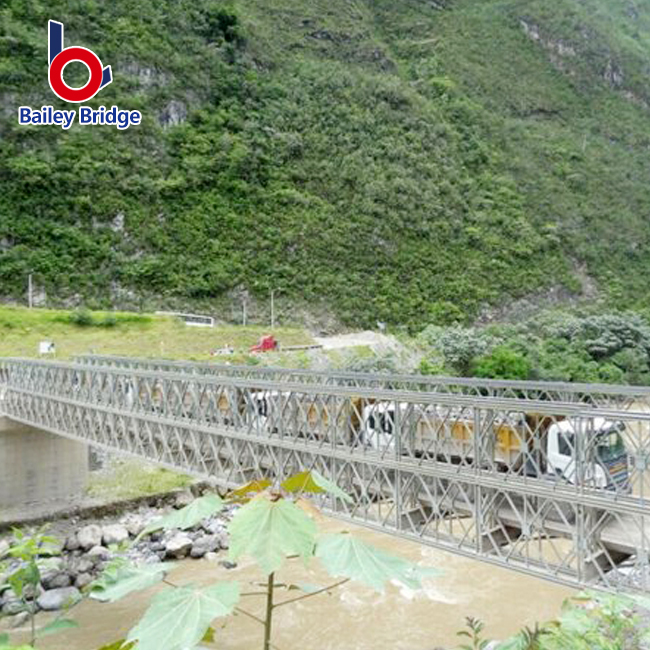
You must translate specific project requirements into exact modular configurations. A 40-ton logging truck exerts entirely different forces than a 60-ton military crawler. Wheeled vehicles create concentrated point loads. Tracked machines distribute their weight over a larger deck area. Engineers scale panel layouts to match these distinct load classifications precisely. You cannot guess the required configuration.
Standardized configurations dictate the final capacity. They scale up by adding truss rows and tiers.
Single-Single (SS): Suitable for pedestrian paths or light vehicular traffic. Use this setup for short spans only. It offers minimal resistance to heavy bending forces.
Double-Single (DS) & Double-Double (DD): These represent the sweet spot for standard commercial transport. They align well with AASHTO HS20 or HS25 equivalents. The DD setup adds a second vertical tier. This increases vertical stiffness significantly.
Treble-Single (TS) & Treble-Double (TD) with Reinforcing Chords: Required for extreme heavy machinery. You need this complex setup for mining equipment. It also supports exceptionally long spans effectively. Reinforcing chords add crucial momentum resistance.
We must differentiate static and dynamic loads clearly. A dynamic load allowance is legally mandatory for safety. Fast-moving wheeled vehicles brake heavily. They bounce over deck seams. This multiplies the effective static weight by up to thirty percent. Slow-moving tracked vehicles spread their weight differently. Impact factors ensure the structure absorbs sudden kinetic shocks without snapping. Engineering teams must calculate this impact factor based on vehicle speed. Typical military specifications demand high dynamic allowances.
Configuration Type | Typical Application Profile | Common Load Classification Limits |
|---|---|---|
Single-Single (SS) | Pedestrian, Light Utility Vehicles | Up to 10 Tons |
Double-Single (DS) | Commercial Trucks, Relief Transport | AASHTO HS20 (Approx. 36 Tons) |
Double-Double (DD) | Heavy Freight, Construction Vehicles | AASHTO HS25 (Approx. 45 Tons) |
Treble-Double (TD) | Mining Equipment, Military Crawlers | Exceeding 60 Tons |
Span length directly dictates your final load limits. As a span increases, the dead weight of the bridge grows exponentially. This consumes a much larger percentage of your total theoretical capacity. You must account for this fundamental engineering truth. A 20-meter span holds significantly more live weight than a 40-meter span. They might use the exact same panel configuration. The longer span expends most of its strength simply holding itself up in the air.
Deflection limits also rule your procurement decisions. Load capacity isn't just about avoiding total collapse. You must maintain acceptable deflection limits under full loads. Engineers often target an L/400 ratio for safety. This means a 40-meter span can safely sag a maximum of 100 millimeters at the center. Keeping deflection minimal ensures long-term structural longevity. Excessive sagging destroys panel joints over time. It stretches bolts beyond their elastic limits. Once metal stretches plastically, it never recovers its shape. You lose the bridge.
Additionally, you cannot ignore abutment realities. Theoretical capacities mean nothing without solid ground beneath the bearings. Your foundation must support both the dead weight and dynamic live loads simultaneously. A modular Bailey bridge requires heavily engineered concrete supports. In emergency scenarios, engineered gabion walls suffice temporarily. However, if the soil shifts slightly, the bridge geometry fails. Uneven settlement twists the rigid steel frame. This introduces massive torsional shear stresses. The bridge will fail well below its rated capacity if the foundation sinks. Always conduct a thorough geotechnical survey first.
Understanding hidden vulnerabilities separates successful projects from dangerous disasters. You must perform a rigorous risk assessment before procurement. Bridge failures rarely start as catastrophic events. They begin as microscopic flaws inside the components. Buyers must know exactly where to look for these flaws. Do not rely blindly on factory inspection reports.
Constant dynamic loading causes severe micro-wear on panel pins. You must scrutinize pin materials carefully. High-grade alloys like 30CrMnTi provide necessary shear strength. Precision machining prevents loose fits. A loose pin accelerates joint degradation rapidly. It allows the panels to shift during vehicle transit. This creates a destructive hammering effect known as fretting fatigue. Eventually, the pin snaps under shear force. Ask your vendor for specific pin metallurgy data. Demand hardness testing results.
Welding standards represent another critical vulnerability point. A prefabricated steel bridge relies heavily on weld integrity. You must evaluate vendor compliance strictly. Look for strict adherence to AWS D1.5 or EN 1090 international codes. Poor welds contain hidden slag inclusions or porosity. These defects crack open under repeated stress cycles. Require ultrasonic or radiographic testing for all primary structural welds. Visual inspection is never enough.
Corrosion drastically reduces load capacity over time. Improper surface treatment destroys steel rapidly in outdoor environments. Vendors failing to use hot-dip galvanizing to ASTM A123 standards put your project at risk. Paint chips away during assembly. Rust attacks the exposed metal relentlessly. This compromises the cross-sectional area of the chords. Thinner metal means lower bending capacity. Always verify galvanizing thickness before shipping. Expect a minimum of 85 microns for durable protection.
Procurement teams need concrete steps to qualify manufacturers confidently. You cannot rely on sales pitches or polished brochures alone. Follow this shortlisting logic to secure your investment properly. Rigorous vetting prevents dangerous field failures later. Implement these requirements into your formal tender documents.
Request Localized Structural Calculations: Never accept generic brochures or copied charts. Demand specific localized load calculations. A licensed structural engineer must sign these documents. Site-specific finite element analysis (FEA) proves actual safety. FEA models the exact vehicle loads crossing your specific span length. It highlights stress concentrations accurately.
Verify Third-Party Certifications: Look for credible external stamps of approval. SGS, Bureau Veritas, or CE marking should appear on raw materials. These marks must also cover finished fabricated components. Third-party audits ensure the factory maintains its quality management systems. They prevent unauthorized material substitutions.
Demand Trial Assembly Validation: Insist on a complete factory trial assembly. You must execute this step prior to shipping. It verifies component interchangeability perfectly. Workers assemble a section of the bridge in the yard. They measure the pre-camber arch. This prevents disastrous on-site construction delays. If parts do not fit at the factory, they will not fit in the field.
Audit the Coating Reports: Request the official galvanizing batch records. Cross-reference the coating thickness against international standards. Ensure the zinc coating covers all internal hollow sections. Uncoated internal tubes rust from the inside out invisibly.
These validation steps remove guesswork from the procurement equation. They force vendors to prove their technical competence upfront. Good manufacturers welcome this level of scrutiny.
The safety and long-term viability of a Compact 321 Bailey Bridge depend entirely on strict engineering oversight. Accurate load modeling ensures you select the proper panel configuration. High-yield materials prevent premature structural fatigue. Strict quality control keeps manufacturing tolerances tight. Never compromise on these three foundational pillars. Doing so jeopardizes human life and project timelines.
As your immediate next step, audit your specific localized load classifications carefully. Verify exact requirements for AASHTO, Eurocode, or local transport equivalents. Then, request an itemized Bill of Materials (BOM) from your shortlisted vendors. Cross-reference this BOM alongside their localized structural proof. Insist on material test certificates for the steel. This rigorous validation guarantees a resilient, safe infrastructure asset.
A: It typically reaches up to 51–60 meters unassisted. However, load capacity drops significantly at this extreme length due to dead weight. Achieving this maximum span usually requires a heavily reinforced Treble-Double (TDR) configuration. Always consult a licensed structural engineer for any spans exceeding 40 meters.
A: Yes, they support heavy tracked vehicles. However, tracked machines distribute weight differently than wheeled commercial trucks. You must upgrade the decking system accordingly. Engineers often utilize orthotropic steel decks for these applications. You must model the specific track-contact area to ensure localized deck panel safety.
A: The HD200 generally handles heavier loads over longer spans. This mechanical advantage stems from its taller panel height (2.134m versus 1.5m). However, the 321 model remains far more cost-effective. It is also easier to transport and assemble rapidly for standard commercial load applications.
A: Yes, steel grade matters immensely. Lower-grade steel suffers from permanent plastic deformation under a single heavy overload event. This renders the temporary structure completely unsafe immediately. Warped components also become impossible to disassemble safely. You lose the ability to reuse the bridge for future projects.
