Tel: +86 15262904857 E-mail: overseas@jsbaileybridge.com
- All
- Product Name
- Product Keyword
- Product Model
- Product Summary
- Product Description
- Multi Field Search


Views: 0 Author: Site Editor Publish Time: 2026-07-24 Origin: Site


Constructing a reliable bridge demands precision, durability, and a deep understanding of structural physics. Among the most efficient designs, the truss framework relies heavily on alternating tension and compression members to distribute weight across a gap. Selecting the right materials for these structures requires balancing load capacity, span requirements, environmental conditions, and budget constraints. Relying solely on initial build costs often leads to poor long-term outcomes. Engineers must account for rigorous maintenance cycles, shifting regulatory demands, and highly corrosive local environments.
This guide provides an evidence-based breakdown of primary construction materials. We evaluate their operational realities in the field. You will discover how industry standards, such as AASHTO guidelines, directly shape engineering decisions. Ultimately, this breakdown will guide your procurement strategy and ensure you build durable, compliant infrastructure.
Steel is the dominant standard: High-strength structural steel is the primary material for modern truss bridges due to its superior tensile and compressive strength-to-weight ratio.
Material dictates application: Timber is restricted to pedestrian or light-duty spans, while Fiber-Reinforced Polymers (FRP) are emerging solutions for highly corrosive environments.
Modularity accelerates timelines: Standardized steel components, as seen in the bailey truss bridge design, drastically reduce deployment time and specialized labor requirements.
Total Cost of Ownership (TCO) overrides initial material cost: Compliance, protective coatings (galvanization/weathering), and long-term inspection requirements must dictate the final material shortlist.
When designing a heavy-duty truss bridge, engineers almost universally specify structural steel. It forms the primary load-bearing framework, encompassing the upper chords, lower chords, diagonals, and vertical members. Steel possesses exceptional ductility. It yields before failing, giving inspectors ample warning of structural fatigue.
Modern projects rely on three primary steel types. Weathering steel develops a protective rust patina, significantly reducing future painting needs. Galvanized steel receives a zinc coating to block moisture and salt. High-strength carbon steel, such as ASTM A709, handles massive stresses in highly customized applications. Using steel enables long spans, safely supports heavy freight or vehicular loads, and guarantees predictable fatigue lifespans.
Timber remains a viable choice for specific, lightweight applications. You will typically find it in pedestrian overpasses, historical restorations, and low-volume state park roads. Builders utilize pressure-treated lumber to resist insects and decay. For longer wooden spans, they rely on glulam, which consists of glued laminated timber layers pressed together for enhanced structural integrity.
Wood offers high aesthetic value and a significantly lower carbon footprint compared to industrial metals. However, it faces distinct limitations. Timber restricts maximum span lengths. It carries lower load ratings and remains highly vulnerable to biological degradation, moisture intrusion, and fire.
Concrete rarely forms the primary truss framework. It boasts tremendous compressive strength but exhibits very poor tensile strength without heavy internal steel reinforcement. Truss designs fundamentally require materials that can handle alternating tension and compression simultaneously.
Instead, concrete serves as a critical supporting element. Construction crews pour concrete for bridge decks, structural abutments, and foundational piers. It provides an incredibly durable driving surface and anchors the superstructure rigidly to the earth.
Advanced composites represent the newest frontier in structural engineering. FRP materials combine strong fiberglass or carbon fibers bound within a tough polymer resin. Designers specify FRP for specialized pedestrian bridges or isolated components located in highly corrosive coastal and chemical environments.
FRP boasts an extremely high strength-to-weight ratio. It weighs a fraction of steel and features zero potential for rust or galvanic corrosion. However, these benefits arrive alongside steep upfront material costs. Furthermore, engineers possess less long-term historical wear data for composites compared to legacy materials.
Primary Bridge Material Comparison
Material | Primary Application | Tensile Strength | Corrosion Resistance | Initial Cost |
|---|---|---|---|---|
Structural Steel | Highway, rail, heavy freight spans | Very High | Moderate (Requires treatment) | Moderate |
Timber (Glulam) | Pedestrian, light park roads | Low | Low (Requires preservation) | Low |
Concrete | Decks, abutments, piers | Very Low (Unless reinforced) | High | Moderate |
FRP / Composites | Corrosive environments, footbridges | High | Extremely High | Very High |
Your structural material must align strictly with anticipated traffic demands. Heavy highway corridors or rail lines mandate high-grade steel. Steel handles dynamic, repetitive loading without sudden failure. Conversely, if you plan a short span under 50 feet meant strictly for light traffic or pedestrians, timber or hybrid options become highly attractive. Evaluating the target live load ensures you do not over-engineer a simple crossing.
The surrounding climate dictates material selection as much as the traffic above it. Coastal regions introduce constant salt spray. Northern climates rely on heavy de-icing salts during winter months. These chlorides accelerate steel oxidation rapidly. In such aggressive environments, you must specify hot-dip galvanized steel, specialized weathering steel, or inert FRP components to prevent rapid structural degradation.
Smart engineering requires looking decades ahead of the ribbon-cutting ceremony. You must conduct a comprehensive Lifecycle Cost Analysis. This involves weighing the upfront material purchase price against routine future maintenance. For example, standard carbon steel might cost less today. However, the future labor and scaffolding required to repeatedly sandblast and repaint it will dwarf the initial savings. Spending more upfront on maintenance-free weathering steel often yields massive financial benefits over fifty years.
Remote project sites introduce complex logistical hurdles. If trucks cannot navigate tight mountain roads, hauling massive custom steel girders becomes impossible. Difficult-to-access sites favor lightweight materials. FRP sections can be carried by hand. Similarly, modular steel components allow crews to transport parts on standard flatbed trailers and assemble them on-site without relying on massive, expensive heavy-lift cranes.
A portable, pre-fabricated modular steel system originated during military operations to rapidly cross bombed-out rivers. Today, a modern bailey truss bridge serves as a standard civil engineering solution. It delivers exceptional strength for emergency scenarios, temporary construction bypasses, and permanent rural infrastructure.
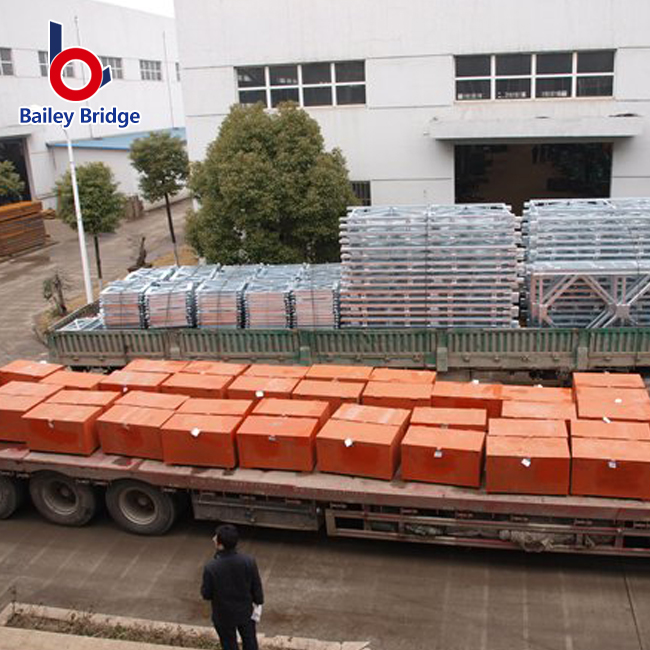
Manufacturers construct these systems from high-yield structural steel. Every component, from the transom to the bracing frames, is engineered for maximum load-bearing efficiency. To guarantee decades of durability in harsh environments, factories typically hot-dip galvanize the steel, encasing it in a thick, protective zinc armor.
No Field Welding: Standardized pinning systems allow parts to lock together seamlessly. This eliminates the need for expensive, certified field welders.
Lightweight Handling: Engineers designed the individual components to be light enough for small manual crews to handle using basic lifting equipment.
Progressive Launching: Crews assemble the structure on solid ground. They push it out over the gap progressively using rollers and a temporary launching nose.
These modular structures are ideal for critical detour routes during long-term highway overhauls. They shine in disaster recovery situations following floods. They also provide excellent permanent solutions for rural logging operations or mining access roads where pouring massive concrete foundations remains financially unviable.
Every structural material must meet stringent transportation authority guidelines. In the United States, materials must comply with AASHTO and FHWA regulations regarding load ratings, stress tolerances, and fatigue resistance. European projects rely on Eurocode standards. Furthermore, publicly funded projects often trigger "Buy America" acts. You must verify that your steel is smelted, rolled, and fabricated domestically to secure government funding.
Custom structural steel fabrication frequently suffers from extended lead times. Steel mills schedule bespoke runs months in advance. Any supply chain disruption halts your construction schedule. Choosing pre-engineered or modular solutions effectively mitigates these delays. Standardized parts sit ready in warehouse inventory, drastically compressing your project timeline from months to mere weeks.
All bridge materials require mandated, routine inspection cycles. Regulators do not allow infrastructure to exist unmonitored. Steel designs require meticulous Fracture-Critical Member (FCM) inspections. Technicians use ultrasonic and magnetic tools to find microscopic cracks. Timber requires invasive rot, pest, and moisture assessments. Factoring these mandatory inspection labor hours into your overall lifecycle budget is critical for accurate project planning.
Step 1: Define the strict parameters. Establish the exact required load rating (such as an HL-93 highway load). Measure the precise gap span and calculate the expected daily vehicle traffic.
Step 2: Assess environmental constraints. Identify local corrosive threats. Map out road salt usage, coastal humidity, or chemical exposure to swiftly rule out incompatible material grades.
Step 3: Evaluate deployment timelines. Determine your operational deadlines. Decide if your schedule allows for a slow, custom-built solution or if you require a rapid modular steel system to maintain traffic flow.
Step 4: Engage structural engineers. Move beyond general material concepts. Work with certified professionals to specify exact steel grades, gauge thicknesses, and protective coatings for a formal bid package.
Selecting the optimal material for a structural crossing requires looking far beyond initial purchase prices. You must calculate dynamic loads, assess environmental hostility, and prepare for decades of mandated inspections. Ensure you balance these engineering truths against your operational budget.
While heavy-duty steel continues to dominate global highway infrastructure, alternative materials serve distinct, valuable purposes. Specialized composites conquer corrosive environments, while modular pre-fabricated systems offer unmatched speed and logistical flexibility.
Take proactive steps to secure your infrastructure. Consult directly with a certified bridge engineer or trusted manufacturer. Ask them to perform a rigorous lifecycle analysis tailored exactly to your site parameters, ensuring your crossing remains safe for generations.
A: Concrete handles compression extremely well but fails under tension unless filled with massive amounts of rebar. Truss designs inherently rely on alternating tension and compression members to distribute loads. Steel possesses excellent dual-strength properties, making it far more efficient, reliable, and lighter for complex skeletal frameworks.
A: Yes. Builders still construct them primarily for pedestrian nature trails, golf courses, or light-duty rural roads. Timber works well in applications where aesthetic blending with the natural environment is prioritized, and heavy vehicular loads are not a factor.
A: With appropriate material selection, such as weathering steel, and consistent routine maintenance, modern steel bridges offer extensive longevity. Engineers actively design and rate these robust structures to achieve a reliable 75 to 100-year operational design life.
A: Absolutely. While frequently deployed as temporary emergency infrastructure, properly maintained and hot-dip galvanized bailey bridges routinely serve as permanent crossings. They function successfully for decades in rural, agricultural, or private-access applications.
