Tel: +86 15262904857 E-mail: overseas@jsbaileybridge.com
- All
- Product Name
- Product Keyword
- Product Model
- Product Summary
- Product Description
- Multi Field Search


Views: 0 Author: Site Editor Publish Time: 2026-07-09 Origin: Site


Extreme weather events like devastating floods and severe landslides instantly sever critical infrastructure. Local communities become isolated overnight. Vital regional supply chains experience catastrophic halts. The economic and safety costs of these sudden disruptions escalate by the hour.
Agencies face a harsh operational reality during disaster recovery. Permanent bridge reconstruction requires years of planning, environmental studies, and complex construction phases. However, first responders and commercial fleets demand safe access within days. They cannot wait for long-term projects to finish before resuming essential operations.
An emergency temporary bridge serves as the primary strategic solution for rapid infrastructure triage. You will learn how procurement teams and structural engineers evaluate, select, and deploy these modular structures safely. We will explore key geotechnical realities, strategic procurement models, and strict compliance standards guiding successful post-disaster recovery efforts.
Rapid Deployment: Modular designs allow for assembly and installation in days, instantly restoring emergency and commercial access.
Material Reliability: A temporary steel bridge provides the necessary load-bearing capacity for heavy civil and emergency vehicles.
Geotechnical Realities: Successful deployment requires rigorous site assessment to mitigate risks associated with flood-scoured banks and unstable landslide debris.
Flexible Procurement: Agencies can leverage emergency funding (e.g., DOT/FHWA disaster relief) through strategic leasing or purchasing models.
Disaster recovery operations depend entirely on immediate success criteria. First responders need immediate access to isolated communities. Ambulances and fire engines require stable routes to save lives. You must reconnect severed communities to essential resources like clean water and medical supplies. Stabilizing local supply chains remains just as critical to prevent secondary crises.
Consider the massive economic mitigation these structures provide. The cost of inaction is staggering for regional economies. Extended detours create massive inefficiencies for commercial freight fleets. Transit times double or triple. Fuel costs skyrocket for local businesses. Halted commercial transit devastates regional industries dependent on just-in-time delivery models. You must compare these compounding daily losses against the targeted investment in temporary infrastructure. The upfront capital expenditure often pays for itself rapidly by preventing prolonged logistical paralysis.
You should view a rapid deployment bridge as a highly strategic stop-gap. It does not permanently replace destroyed infrastructure. Instead, it serves as a high-performance interim solution. It reliably carries highway-level commercial loads while buying agencies crucial time. Engineers typically need two to five years to design, permit, and fund permanent structures. A temporary crossing allows communities to regain normalcy. Long-term recovery efforts can advance thoroughly in the background without immense public pressure to rush permanent designs.
Best Practice: Always align initial load rating requirements with heavy commercial traffic needs, not just standard passenger vehicles.
Common Mistake: Treating the temporary structure as a permanent 20-year solution. This mindset delays necessary funding applications for permanent replacements.
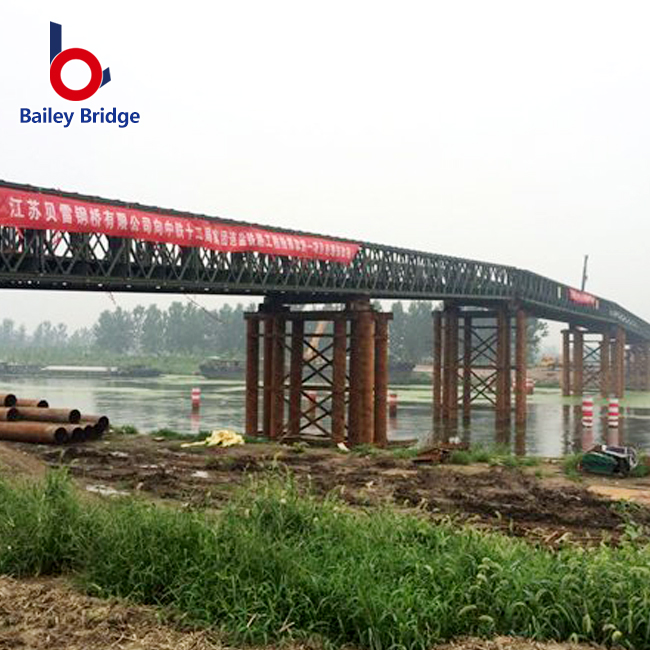
Choosing the right design dictates the entire success of the recovery project. Agencies must match the bridge type to specific, often compromised, site constraints. We generally divide these engineering solutions into two distinct categories based on deployment methodology and structural framework.
First, evaluate modular panel bridges. Many engineers refer to these as Bailey-style bridges. They work exceptionally well for long spans across wide rivers. They easily handle extreme load requirements through interchangeable truss panels. Their primary advantage lies in flexible logistics. You can transport individual steel components via standard commercial flatbed trucks. They navigate narrow, winding, or debris-filled mountain roads easily. Disaster-struck areas rarely offer open, clear highways. Modular systems solve this restricted access problem perfectly. Crews pin the panels together on-site, requiring minimal specialized tools.
Second, consider pre-fabricated or beam bridges. Manufacturers deliver these units in larger, fully assembled longitudinal sections. They represent the ideal choice for shorter spans. However, heavy lifting equipment must be able to reach the installation site safely. Their main advantage is sheer speed. If road conditions allow for heavy crane delivery, installation takes just a few hours. Crews simply lift the sections off the truck and place them onto the prepared abutments.
Material selection strictly dictates structural performance and longevity. The temporary steel bridge dominates the global infrastructure industry. It provides the rigid yield strength necessary to achieve HL-93 compliance. This specific standard ensures the structure supports loaded semi-trucks safely. Steel withstands severe dynamic loads and continuous fatigue from heavy commercial traffic. Engineers occasionally explore lightweight composite options. However, these composites typically serve pedestrian or light-duty needs. Steel remains the undisputed standard for heavy civil and emergency applications.
Procurement teams face rigid technical constraints when selecting emergency infrastructure. They must evaluate span limits carefully against required load ratings. A single-lane bridge carrying light residential traffic requires different engineering than a dual-lane structure handling continuous commercial freight. Engineers calculate necessary span lengths precisely. Longer spans require heavier, reinforced supporting trusses to maintain high load ratings without unacceptable deflection.
Erection methods depend entirely on post-disaster site access. You must assess the ground conditions before choosing a methodology.
Crane-assisted installation offers incredible assembly speed. However, it requires highly stable ground. Cranes need a large, flat, compacted footprint to operate safely. Clear access roads must exist to bring massive lifting machinery to the riverbank. If floods have washed away the approach roads, cranes become useless.
Cantilever launching provides a critical engineering alternative. Floods often destroy access roads completely. Landslides bury stable staging areas under tons of debris. In these complex scenarios, crews assemble the bridge incrementally on the surviving, stable bank. They attach a lightweight launching nose to the front. They then push the entire structure across the gap over heavy-duty rollers. This method removes the need for heavy lifting equipment near unstable, crumbling edges. Counterweights ensure the structure remains balanced during the push.
Financial models heavily shape the procurement strategy. Agencies must actively choose between leasing and purchasing models.
Leasing fits strictly temporary applications perfectly. It works best when permanent repairs will conclude in a few months. Purchasing makes strategic sense for long-term municipal preparedness. State Departments of Transportation often buy these modular systems. Large civil contractors build internal stockpiles. They keep inventory ready in maintenance yards for rapid future disaster response.
Evaluation Criteria | Key Considerations | Ideal Use Case |
|---|---|---|
Load Capacity vs. Span | Balance total length with truss strength to guarantee HL-93 compliance. | Main commercial routes requiring heavy freight transport. |
Erection Methods | Choose crane-assisted or cantilever launching based on machinery access. | Cantilever launching suits washed-out, unstable riverbanks perfectly. |
Financial Model | Lease for short-term gap fixes; Buy to build permanent stockpiles. | State DOTs purchasing inventory for rapid regional deployment. |
Extreme weather permanently alters local geography. Landslides strip away stable topsoil and expose weak bedrock. Raging floods obliterate existing bridge abutments. They compromise the underlying soil bearing capacity entirely. You cannot safely place new heavy structures on compromised ground.
Addressing soil instability forms the foundation of operational safety. We emphasize the strict requirement for comprehensive geotechnical testing before deployment. Engineers must conduct rapid soil borings or dynamic cone penetration tests. They must confirm the remaining earth can handle massive point loads from the new abutments. Ignoring this step leads to immediate structural settlement or catastrophic collapse under heavy traffic.
Scour protection requires equal engineering attention. Temporary foundations face severe risks from secondary flooding events. Crews often utilize driven steel piles or massive precast concrete blocks to anchor the bridge securely. They must fortify these temporary foundations against fast-moving water. Engineers deploy heavy riprap, gabion baskets, or sheet piling to deflect damaging eddy currents away from vulnerable abutments. Water easily undermines unprotected foundations.
We must strongly abandon claims of "foolproof" installation. Post-disaster environments remain highly unpredictable. Implementing a modular crossing demands rigorous safety protocols. Initial proof-load testing validates structural integrity before opening the route to public traffic.
Continuous monitoring remains an absolute necessity. Surveyors must watch for subtle ground settlement over the first few weeks. Engineers must track load-stress variations once the bridge becomes fully operational. Routine visual inspections prevent secondary failures. You must check bolted connections, pin tolerances, and abutment stability regularly. Proactive maintenance ensures the structure safely completes its multi-year operational lifespan.
Safety dictates strict regulatory alignment across all infrastructure projects. Every temporary structure must adhere to rigorous local and federal transportation standards. In the United States, this means strictly following AASHTO (American Association of State Highway and Transportation Officials) LRFD design specifications. It also involves complying with FHWA (Federal Highway Administration) safety guidelines. Meeting these exacting standards guarantees structural reliability under punishing conditions.
Compliance directly impacts financial recovery. Compliant, professionally engineered temporary bridges frequently qualify for federal emergency relief reimbursement. Agencies can recover substantial procurement and installation costs. However, they must maintain specific engineering documentation. They must explicitly prove the structure meets required national highway standards before applying for relief funds.
We recommend a clear, actionable shortlisting logic for expedited procurement:
Step 1: Conduct an emergency site survey. Measure the physical gap accurately. Define the necessary load rating based on expected commercial detours. Conduct rapid soil bearing tests on both embankments to verify foundation viability.
Step 2: Execute rigorous vendor evaluation. Assess immediate hardware inventory availability. Evaluate the vendor's internal engineering support capabilities. Confirm their proven expertise in complex launch methods, especially cantilever pushes in constrained environments.
Step 3: Expedite SOW and deployment scheduling. Draft a rapid Statement of Work defining deliverables. Finalize the deployment schedule hour by hour. Mobilize transport trucks immediately to bring components to the staging area.
An emergency infrastructure response bridges the crucial gap between immediate disaster triage and long-term community recovery. Rapid modular solutions instantly restore critical lifelines for isolated regions. They mitigate severe economic hemorrhaging by reconnecting essential supply chains within days rather than years.
Hardware alone cannot solve complex post-disaster challenges. The right vendor delivers robust steel components alongside critical engineering expertise. They help you navigate compromised soils, severe scour risks, and highly challenging installation logistics safely. An engineered approach ensures public safety remains paramount.
Infrastructure planners and emergency coordinators must act decisively. We strongly encourage you to request an immediate site assessment today. Consult a dedicated structural engineering specialist to discuss available modular inventory. Finalize your deployment logistics now to ensure your community recovers swiftly from the next extreme weather event.
A: Installation speed depends heavily on span length and site access. Components generally arrive on-site within 24 to 48 hours. Assembly and launching take anywhere from a few days to a couple of weeks, depending entirely on necessary ground preparation and abutment stabilization.
A: Yes. When engineers design them to meet strict local highway standards, such as the HL-93 rating, they provide immense structural safety. They comfortably support loaded semi-trucks, heavy commercial freight, and massive emergency debris-clearing equipment.
A: Yes. Crews easily install modular systems without heavy cranes. They assemble the lightweight steel sections on one stable side of the gap. They then use a cantilever launching method to push the structure across rollers, making it ideal for complete washout zones.
A: Once permanent construction concludes, crews dismantle the modular units. If leased, the agency returns the components to the supplier. If purchased, the state DOT or contractor stores the sections in their inventory for rapid deployment during the next emergency.
