Tel: +86 15262904857 E-mail: overseas@jsbaileybridge.com
- All
- Product Name
- Product Keyword
- Product Model
- Product Summary
- Product Description
- Multi Field Search


Views: 0 Author: Site Editor Publish Time: 2026-07-01 Origin: Site


Infrastructure projects, disaster relief, and military operations face a universal challenge. They require rapid crossing solutions without compromising load safety. Delays in establishing these critical connections can derail entire operations. Blocked access routes severely impact supply chains and emergency response times.
Choosing between a modular, pre-engineered system and a permanent, custom-built structure creates a significant decision bottleneck. Teams must weigh critical trade-offs. These include lead time, heavy site preparation, and financial predictability. Making the wrong choice often leads to budget overruns or unacceptable project delays.
This guide objectively evaluates both structural systems. We will compare deployment speed, engineering capabilities, and lifecycle returns. You will see direct comparisons of logistical realities and load thresholds. Ultimately, this breakdown helps procurement and engineering teams shortlist the right solution for their specific site demands.
Deployment Speed: The Compact 321 Bailey Bridge significantly reduces installation time from months to days utilizing standard hand tools and minimal heavy machinery.
Logistical Footprint: Modular components of the 321 system fit into standard shipping containers, whereas traditional bridges require specialized oversize transport.
Structural Application: Traditional steel structures remain superior for permanent, multi-lane, long-span highway networks requiring minimal maintenance.
Financial Risk: Prefabricated bridges offer a highly predictable upfront cost with reusability, lowering the risk profile for temporary or emergency infrastructure.
Engineers define this system as a standardized prefab truss bridge. It utilizes pinned and bolted interchangeable steel panels. The design prioritizes extreme modularity. Manufacturers pre-fabricate every component to exact tolerances. This ensures parts fit together seamlessly on site. You do not need specialized fabrication skills to connect them. The primary structural components include welded steel panels, transoms, stringers, and decking.
The true genius of this architecture lies in its launch methodology. Teams design these modular units for rapid, cantilever-style launching. They push the bridge across the gap without relying on temporary falsework. You build the bridge on rollers on one side of the river. A lightweight launching nose leads the structure across the span. Once the nose reaches the far bank, crews remove it and lower the main bridge onto its bearings. This method minimizes environmental impact in the waterway below.
In contrast, a custom-engineered steel bridge structure follows a highly site-specific design path. These projects typically involve heavy plate girders, box girders, or complex bespoke truss designs. Engineers spend months drafting specific blueprints based on localized geotechnical data. Fabricators then build massive steel sections in controlled factory environments. These structures prioritize long-term permanence and aesthetic integration into urban landscapes.
This traditional approach heavily relies on extensive site preparation. Contractors must construct deep foundations, such as driven piles or large concrete abutments. The site becomes a massive construction zone. Workers perform extensive on-site welding, custom fabrication, and heavy concrete pouring. The process requires temporary supports built directly into the riverbed or valley floor. This complexity inherently extends project timelines and increases vulnerability to weather delays.
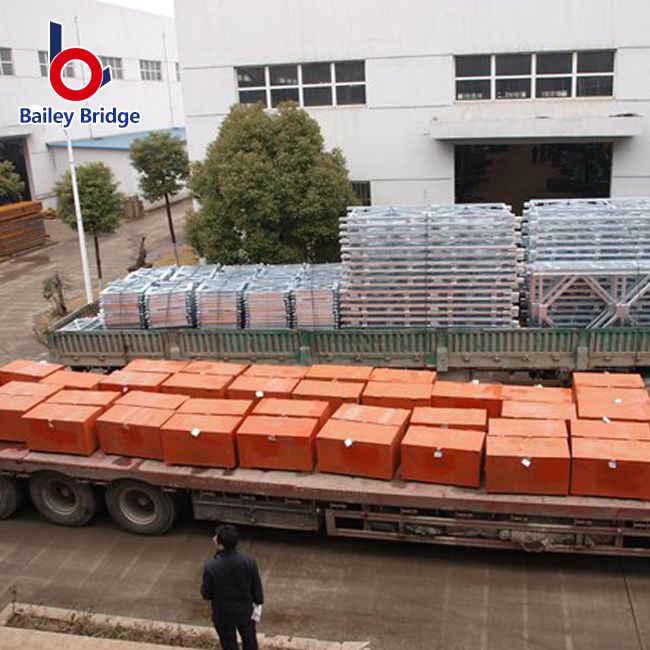
Logistics dictate the feasibility of any remote infrastructure project. The Compact 321 Bailey Bridge offers distinct advantages here. Manufacturers standardize all components to fit inside standard 20-foot or 40-foot freight containers. You can ship them globally via standard commercial freight. They travel easily on narrow mountain roads. This makes them ideal for remote, restricted-access sites where heavy transport vehicles simply cannot go.
Traditional builds face severe transportation bottlenecks. Large prefabricated girders require specialized oversized load permits. Transporting them demands complex routing plans. You often need police escorts to navigate public highways. Furthermore, the construction site requires wide access roads to accommodate extended flatbed trucks. If a site sits in dense jungle or mountainous terrain, delivering traditional steel members often becomes impossible without blasting new roads.
The assembly process sharply highlights the differences between these two methodologies. We can break down the cantilever push-out method into distinct, manageable stages.
Site Layout: Crews level a small area on the launching bank to place the assembly rollers.
Panel Pinning: Workers manually connect the steel panels using heavy-duty pins. They secure these with safety clips.
Decking Installation: Teams lay transoms and steel deck plates as the bridge extends backward.
Cantilever Launch: A standard vehicle or manual winch pushes the bridge forward over the rollers.
Landing and Seating: Crews dismantle the launching nose and lower the main span onto permanent bearings.
A trained but non-specialized crew easily executes this process. They use standard hand tools and basic lifting aids. This approach entirely eliminates the strict requirement for heavy cranes. Conversely, a traditional build mandates heavy-lift cranes. It requires specialized welding crews. Contractors must erect extensive scaffolding and falsework. Heavy machinery dominates the site, escalating fuel costs and logistical complexity.
Project managers must carefully evaluate the timeline from procurement to active traffic. Modular systems operate on a highly compressed schedule. Because parts sit in inventory, suppliers can ship them immediately. A procurement-to-traffic timeline often spans just a few weeks. The physical assembly frequently takes only days. Custom builds follow a multi-month or even multi-year timeline. Engineering approvals, custom fabrication, and complex erection phases demand immense time investments.
Deployment Comparison Metrics
Feature | Modular Bridge System | Traditional Steel Build |
|---|---|---|
Transport Format | Standard 20ft/40ft Containers | Oversized Escort Loads |
Machinery Required | Rollers, Winches, Light Forklifts | Heavy-Lift Cranes, Pile Drivers |
Labor Skill Level | Trained General Labor | Certified Welders, Riggers |
Average Installation Time | 5 to 15 Days | 6 to 24 Months |
A common misconception assumes that rapid deployment sacrifices structural capacity. However, the modular bridge handles standard highway loads effortlessly. Engineers configure the panels into different trusses. They use single, double, or triple rows. They can also stack them in multiple tiers. This flexibility allows the structure to support emergency vehicles, heavy commercial trucks, and tracked machinery. Typically, these systems achieve robust performance up to specific span limits. A single span usually maxes out around 60 to 65 meters before requiring intermediate supports.
We must clarify when a custom permanent approach becomes strictly mandatory. Modular systems have limits. If your project dictates spans exceeding 70 meters without intermediate piers, you must pivot to custom plate girders or suspension designs. Continuous heavy cyclic loading over multiple decades also favors a permanent structure. Multi-lane highway requirements, where bridges must span four to six lanes wide, universally demand custom engineering.
Both options require strict adherence to international engineering standards. In the United States, designs typically follow AASHTO (American Association of State Highway and Transportation Officials) guidelines. The FHWA also provides specific directives for prefabricated steel bridges. Modular bridges hold full compliance with these rigorous load ratings. They undergo exhaustive physical testing to verify shear and bending limits.
However, engineering behaviors do differ under traffic. While modular systems prove highly resilient, their deflection characteristics vary. A pinned-and-bolted structure naturally exhibits slightly more vertical deflection and movement than a fully welded continuous girder. Fatigue characteristics also differ. The cyclic stress on steel pins requires different engineering calculations compared to the stress on welded girder joints. Engineers factor these variables into the chosen load class and panel configuration.
Financial predictability drives many procurement decisions. Modular bridging offers extremely high predictability. Material costs remain fixed because components are mass-produced off-the-shelf. The manufacturer provides a precise quote based on span and load requirements. Furthermore, labor and equipment costs decrease drastically. You do not pay for month-long crane rentals or specialized high-wage welding teams. Weather delays rarely inflate the budget because assembly happens so quickly.
Traditional builds introduce higher variability. Custom engineering requires significant upfront consulting fees. Extended labor hours stretch the budget. Complex erection sequences often face weather delays. If heavy rains flood the site, foundation work stops immediately. Every day of delay adds massive rental and labor costs. These hidden variables frequently push custom projects beyond their initial financial estimates.
Contractors and government agencies increasingly view modular structures as commercial assets. They provide excellent ongoing return on investment. Once a temporary detour or emergency phase ends, crews disassemble the bridge. They pack the panels back into containers. They store them in local depots. When the next project or natural disaster occurs, they redeploy the exact same asset. This reusability completely transforms the capital expenditure model for infrastructure teams.
We frame traditional bridges differently. They represent one-time, location-specific sunk costs. You design a girder bridge for one specific valley profile. You cannot move it later. However, this sunk cost secures a highly durable permanent asset. A properly maintained custom structure routinely achieves a 75 to 100-year design life. It integrates into the permanent highway network, offering decades of uninterrupted service.
All steel infrastructure demands routine maintenance. Teams must monitor modular systems for mechanical integrity. Best practices for pinned and bolted systems include:
Scheduling regular torque checks on all primary structural bolts.
Inspecting panel pins and safety clips for wear after heavy heavy-haul events.
Monitoring the anti-corrosion galvanization layer for scratches or environmental degradation.
Clearing debris from the seating bearings and roller mechanisms.
Traditional welded structures often feature lower routine mechanical maintenance. You do not need to check thousands of bolts. However, they require extensive, expensive repainting cycles to prevent rust. Inspections focus heavily on weld fatigue, deck spalling, and foundation scouring. While routine checks may be less frequent, major rehabilitations on permanent structures involve massive engineering efforts and lane closures.
Certain project profiles perfectly align with modular deployment. You should specify this system when facing urgent timelines. Disaster recovery teams rely on them after floods wash away concrete spans. Military bridging operations use them for rapid troop advancement. Civilian contractors frequently deploy them to create temporary detours. This keeps traffic flowing during major highway upgrades.
Remote locations highly favor modular logistics. If a site prohibits heavy-machinery access, containerized transport solves the problem immediately. Additionally, projects requiring semi-permanent crossings for mining or logging operations benefit greatly. You can dismantle the bridge and relocate it once the extraction site closes.
You should retain a traditional approach for permanent urban infrastructure. City planning often requires specific architectural aesthetics that standard trusses cannot provide. Multi-lane, high-speed, and high-volume traffic routes demand continuous, smooth decking systems. Ultra-long clear spans over major waterways or deep shipping channels universally require custom suspension, cable-stayed, or continuous girder designs. A traditional build remains the gold standard for these permanent, high-profile environments.
Procurement teams must gather specific data before requesting vendor quotes. Precision early on eliminates revision delays. First, define the exact clear gap width. Measure from stable bank to stable bank. Second, determine the maximum expected load class. Will the bridge carry standard passenger cars, or will 80-ton mining dump trucks cross it? Finally, test the soil bearing capacity on both banks. Even a lightweight superstructure requires stable ground to support the abutment plates. Gather these three metrics before contacting structural engineers for a preliminary site assessment.
The primary choice hinges entirely on the permanence of the requirement and the urgency of deployment.
Modular systems drastically reduce logistical footprints, enabling rapid installation in restrictive environments without heavy cranes.
The Compact 321 Bailey Bridge stands as the definitive choice for rapid deployment, high reusability, and budget predictability.
Custom traditional builds remain the necessary standard for permanent, high-volume, multi-lane spans with architectural demands.
Action Step: Consult specialized structural engineers with your specific span length, load class, and soil data to secure an accurate preliminary site assessment and bridge configuration.
A: The standard limit typically reaches around 60 to 65 meters for a single span. This depends heavily on the chosen load class and panel configuration. Longer spans require heavier multi-row trusses, which increases dead weight. For gaps exceeding this limit, engineers must design intermediate piers to support continuous multi-span bridge configurations.
A: Yes. Engineers achieve extreme load capacities using multi-row and multi-tier panel configurations. By placing up to three rows of panels side-by-side and stacking them two or three stories high, the shear and bending capacity scales dramatically. However, increasing the load rating significantly reduces the maximum safe span length.
A: The HD200 system generally utilizes larger panel dimensions and offers higher shear capacity. This makes it suitable for heavier loads over longer spans. The 321 system is typically lighter. Its smaller components make it faster to deploy by hand or with minimal machinery. The choice depends on required capacity versus manual portability.
A: No. While highly favored for temporary detours, they serve perfectly well as permanent infrastructure. Manufacturers treat the steel with heavy-duty hot-dip galvanization. With routine maintenance, torque checks, and basic rust prevention, these pre-engineered structures easily provide resilient, safe service for several decades.
