Tel: +86 15262904857 E-mail: overseas@jsbaileybridge.com
- All
- Product Name
- Product Keyword
- Product Model
- Product Summary
- Product Description
- Multi Field Search


Views: 0 Author: Site Editor Publish Time: 2026-07-06 Origin: Site


In restricted work zones, disaster recovery sites, and urban infrastructure upgrades, standard bridge construction is often not viable. Time and space constraints consistently demand immediate, flexible alternatives. Project engineers and emergency planners face a critical logistical challenge. They require modular infrastructure meeting strict state Department of Transportation (DOT) standards. Furthermore, they need these systems deployed without relying on massive staging areas or disrupting local ecosystems. Traditional concrete or permanent steel structures simply take too long to mobilize and build under such pressure.
This guide provides a technical evaluation of modern modular engineering solutions. It details how the Compact 321 design addresses specific load, span, and compliance requirements across various temporary traffic scenarios. You will learn exactly how to match structural capacities to complex site constraints. We will also explore essential safety benchmarks for pedestrian routes, commercial vehicle transit, and emergency rapid-response deployments.
Versatile Deployment: The Compact 321 design scales efficiently from lightweight pedestrian corridors to heavy-duty commercial vehicle transit.
Site-Specific Adaptability: Modular components allow for rapid assembly in narrow urban streets or unstable disaster zones with minimal heavy equipment.
Rigorous Compliance: Systems must be evaluated against local DOT design criteria, MUTCD work zone standards, and HL-93 load ratings to ensure legal and operational safety.
Risk Mitigation: Successful deployment relies heavily on precise pre-construction site assessment, particularly regarding abutment engineering and staging logistics.
Standard detours cause unacceptable delays in emergency response networks. They disrupt commercial transit schedules and sever active pedestrian routes. Projects located in narrow urban corridors or ecologically sensitive areas require minimal-footprint solutions. Prolonged road closures frustrate local communities and stall regional commerce. To prevent these bottlenecks, engineers need a highly reliable temporary traffic bridge to keep traffic flowing safely during extended construction phases.
The pinned-panel modular design offers distinct mechanical advantages over traditional bridge building. Characterized by its precision-engineered interchangeable parts, the system features an exceptionally high strength-to-weight ratio. Construction crews can perform rapid cantilever launch installations directly from one bank. They can assemble and push the structure across large gaps without ever needing in-water supports. This methodology protects sensitive waterways below and avoids complex environmental permitting delays associated with driving piles.
A successful deployment must achieve three primary performance metrics:
It minimizes traffic disruption entirely by maintaining original route capacities and preventing severe local detours.
It meets strict regulatory safety standards, including Americans with Disabilities Act (ADA) compliance for pedestrian usage and legal load limits for heavy vehicles.
It adheres tightly to strict project timelines, ensuring mainline construction remains on schedule.
Project teams often focus on safely routing foot and bicycle traffic around active construction zones. They must safely navigate vulnerable users over natural obstacles, trenches, or busy roadways. A well-designed pedestrian Bailey bridge configuration easily handles these specific demands. Technical specifications for these applications utilize highly specialized decking. You will commonly see anti-slip coatings and closed-surface panels to prevent tripping hazards. Engineers also install high-visibility safety rub rails and specialized parapets to protect cyclists and pedestrians from fall risks.
When specifying a pedestrian configuration, you must ensure strict compliance with ADA slope and width requirements during your evaluation. Ramps cannot exceed specific gradient limits, and clear widths must accommodate wheelchairs passing one another. Address vibration mitigation early in the design phase. Properly stiffened panels ensure user comfort and prevent unsettling swaying during heavy commuter foot traffic.
Highway engineers must maintain a steady flow for local traffic, regional freight, and heavy construction equipment. Forcing heavy trucks onto residential detours causes massive logistical headaches and road damage. You can overcome this obstacle by specifying multi-lane modular configurations. Heavy-duty steel decking and heavily reinforced transom placements support massive dynamic weights. These components lock together to create a rigid platform capable of absorbing continuous stress.
Always verify that the system accommodates dynamic impact loads caused by braking and accelerating trucks. Check the required Highway Load (HL-93) specifications mandated by the American Association of State Highway and Transportation Officials (AASHTO). Match these structural ratings against specific state DOT axle configurations to ensure legal compliance. Never rely on generic capacity claims when routing commercial freight.
Best Practice: Require your vendor to provide state-specific stamped engineering drawings for your heavy-duty application.
Common Mistake: Failing to account for the turning radius of long commercial trailers at the bridge approaches, leading to side-rail collisions.
Natural disasters, sudden washouts, and structural failures require immediate restoration of access. Isolated communities depend heavily on rapid deployments following severe storms. Utilizing stock components allows for exceptional rapid mobilization. Crews can transport parts on standard flatbed trucks and install these structures directly over existing damaged structures. They also fit perfectly in narrow street profiles where traditional heavy construction equipment simply cannot maneuver.
Assess the emergency logistics network of your chosen vendor thoroughly. In disaster scenarios, parts must arrive within hours, not weeks. The system must assemble quickly using minimal manual labor. It should require only light lifting equipment, such as a standard rough-terrain forklift or a small hydraulic excavator, to position the panels and transoms.
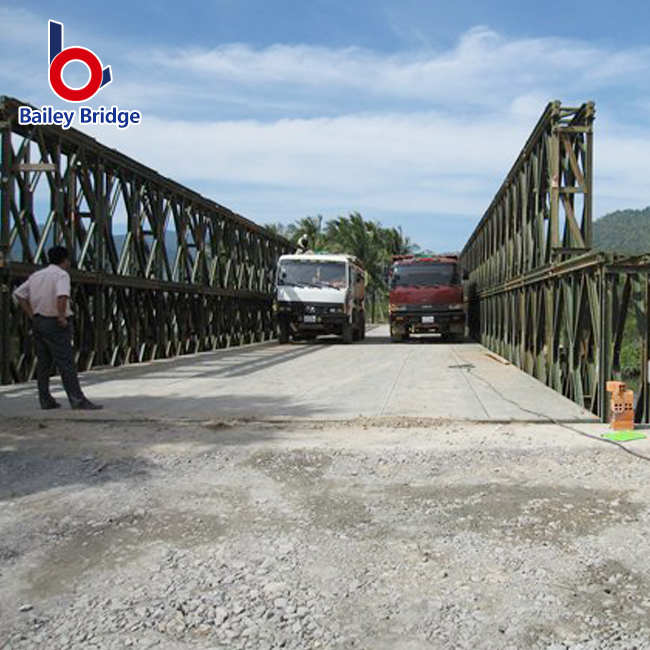
Every temporary crossing requires a careful engineering trade-off analysis. Longer clear spans naturally require deeper structural trusses. To cross wide rivers or deep ravines, engineers might need multi-story or multi-row panel configurations. Adding rows and tiers heavily impacts the total dead weight of your Compact 321 bridge system. Consequently, heavier structures demand significantly greater abutment strength to prevent soil failure. Always request specific load charts from the manufacturer. Ensure these charts match your exact span length and anticipated traffic type perfectly.
Structural Configuration Analysis
Configuration Type | Ideal Span Range | Typical Traffic Application | Abutment Demand |
|---|---|---|---|
Single Row, Single Tier (SS) | Short (Up to 30m) | Pedestrian / Light Vehicle | Low |
Double Row, Single Tier (DS) | Medium (30m - 45m) | Standard Highway (HL-93) | Moderate |
Double Row, Double Tier (DD) | Long (45m - 60m+) | Heavy Construction Freight | High |
You must conduct a rigorous logistical assessment before any steel arrives on site. Evaluate the physical size of modular components against your available staging area. Check the turning radii of transport vehicles navigating your active work zone. Many urban areas severely restrict large flatbed trucks from turning corners.
Next, assess your structural launch mechanics. Determine whether your site permits a traditional cantilever launch, which requires ample space behind the abutment to assemble the bridge and a launching nose. If buildings or cliffs prohibit a cantilever launch, evaluate if placing a heavy-lift crane is feasible and safe.
Regulatory alignment remains non-negotiable for public infrastructure projects. Ensure the system design precisely aligns with AASHTO specifications for temporary structures. You must follow local DOT design criteria closely, as some states mandate thicker decking or specific guardrail heights. Furthermore, adhere strictly to the Manual on Uniform Traffic Control Devices (MUTCD) temporary traffic control guidelines. Proper signage, approach barriers, and reflective markers protect both the driving public and your construction personnel.
Geotechnical conditions ultimately dictate your installation success. A modular bridge is genuinely only as strong as its foundation. You must transparently assess soil bearing capacity early in the planning phase. Determine the necessity for engineered concrete abutments, steel grillages, or timber distribution beams. Ignoring soil testing in emergency scenarios often leads to dangerous abutment settlement, causing the entire truss system to sag under heavy vehicle loads.
Staging and assembly bottlenecks ruin tight project timelines. A lack of adequate laydown area causes severe installation delays. You must map out exactly where components will rest upon delivery. If crews have to move panels multiple times to clear pathways, labor hours will inflate rapidly.
Maintenance durability matters significantly for long-term temporary deployments. If you plan to leave the structure in place for one to three years, evaluate its corrosion resistance. Check the hot-dip galvanization quality of all steel members. Establish a strict, documented maintenance schedule for inspecting decking panels, tightening sway braces, and checking all primary pin connections.
Infrastructure decision makers often debate between renting and buying equipment. Renting serves as an ideal, flexible solution for single, short-to-medium-term projects. We generally define these as bypass deployments lasting under 24 months. Rentals also work perfectly for emergency stop-gap measures while you design a permanent structure. Conversely, purchasing proves highly advantageous for government entities. State DOTs, county municipalities, and large heavy civil contractors with recurring emergency response needs benefit greatly from owning their inventory. Owning components readies your crews for immediate deployment when the next washout occurs.
Prioritize manufacturing partners providing comprehensive, in-house engineering support. Look for vendors offering stamped drawing capabilities tailored specifically for your state's regulations. Clear, visual installation manuals prevent site confusion and keep crews safe. Furthermore, vendors who offer on-site technical advisory services dramatically reduce assembly risks. Having an experienced bridge technician guiding your local crew prevents costly rework.
Conduct a thorough pre-construction site survey immediately. You must define the exact clear span required from bank to bank. Outline your required lane widths and anticipated vehicle load classifications. Finally, measure your staging area dimensions accurately before formally requesting vendor engineering quotes.
Engineered modular systems bypass critical infrastructure bottlenecks effectively when specified accurately against site and load realities.
Thorough geotechnical preparation and soil testing prevent dangerous foundation settlement during heavy vehicle transit.
Adhering strictly to state DOT guidelines and MUTCD safety regulations protects construction crews and public users alike.
Pre-planning your staging areas and launch mechanics eliminates costly assembly delays in tight urban spaces.
Success hinges entirely on marrying modular hardware capabilities with rigorous site preparation. Contact our engineering team today to schedule a site-specific load evaluation, or request comprehensive technical specifications tailored perfectly for your upcoming infrastructure project.
A: Maximum clear spans depend entirely on the required load class. Pedestrian configurations can span significantly farther than heavy vehicle setups without needing intermediate supports. By utilizing multi-row and multi-tier structural configurations, engineers can safely achieve spans exceeding 60 meters for highway traffic. Always consult manufacturer load charts for specific span capabilities based on your exact weight requirements.
A: Modularity has distinct engineering limits. While the main truss panels remain interchangeable, you cannot simply drive trucks over a pedestrian setup. The transoms, steel decking panels, and foundation abutments must be engineered specifically for anticipated heavy vehicle loads from day one. Upgrading later usually requires a complete structural rebuild and new foundations.
A: Installation timeframes vary based on structural complexity and site readiness. Emergency installations utilizing stock components can finish in just a few days. Conversely, planned long-span commercial projects might take several weeks to assemble and launch. Ultimately, site preparation, staging space efficiency, and concrete abutment curing times dictate your realistic deployment timeline.
A: Every emergency deployment requires adequate soil bearing capacity to prevent structural settlement. Depending on the unique geotechnical conditions, crews might use heavy timber mats, precast concrete sills, or engineered steel grillages. These structural elements distribute the massive point loads of the bridge safely into the ground, ensuring absolute stability during vehicle crossings.

