Tel: +86 15262904857 E-mail: overseas@jsbaileybridge.com
- All
- Product Name
- Product Keyword
- Product Model
- Product Summary
- Product Description
- Multi Field Search


Views: 0 Author: Site Editor Publish Time: 2026-07-04 Origin: Site


Mobilizing heavy equipment across difficult terrain often becomes a critical bottleneck in remote infrastructure projects. You cannot afford to spend months building preliminary access roads. Project delays compound quickly when crews wait for safe crossing points. Traditional methods usually fall short. Custom-built temporary spans demand excessive engineering time. They also require highly expensive materials. Undersized culverts risk catastrophic failure under heavy machinery loads. You need a reliable middle ground. We introduce the Compact 321 bridge system. It offers an engineered, scalable solution designed to accelerate site access. This modular system meets strict heavy-haul load requirements without unnecessary complexity. We will explore the structural mechanics making these bridges highly adaptable. You will learn how to evaluate site terrain, plan logistics, and execute rapid deployment. We maintain a pragmatic tone focused entirely on logistical realities. You will not find marketing hyperbole here.
Deployment Speed: Modular components allow for rapid, sequential assembly, drastically reducing site-prep timelines.
Scalable Capacity: Standardized steel panels can be configured for varying span lengths and heavy equipment load classes (e.g., HS20 / HL93).
Logistical Efficiency: Designed for transport on standard flatbed trucks, eliminating oversized-load logistical hurdles in remote areas.
Lifecycle ROI: 100% reusable and reconfigurable, allowing construction firms to transition the asset from a temporary construction access bridge to future project sites.
Delayed heavy equipment mobilization creates severe financial impacts on remote jobsites. When massive excavators and crawler cranes sit idle, standby costs skyrocket. Equipment rentals drain capital every hour they remain inactive. Logistics teams struggle to reroute deliveries. You also risk missing narrow weather windows. A two-week delay can push a project directly into the rainy season. This turns manageable terrain into impassable mud. Safety incidents spike when operators attempt to ford unstable rivers. The financial bleeding stops only when a reliable crossing exists.
Construction managers frequently face a frustrating dilemma. You must choose between over-engineering a temporary crossing or under-engineering it. Building a permanent-grade concrete bridge for temporary access drains your budget. It also demands lengthy curing times. Conversely, throwing down undersized culverts invites structural failure. It creates severe safety hazards for your operators. You need a pragmatic balance between speed and structural integrity.
A viable access solution must meet specific success criteria. You cannot rely on guesswork when crossing unpredictable terrain. Consider these core requirements for remote infrastructure deployments:
Immediate deployment using standardized, pre-engineered steel parts.
Minimal foundational footprint to reduce unnecessary earthwork.
Predictable, certified load ratings for heavy haulers.
Straightforward demobilization once the project concludes.
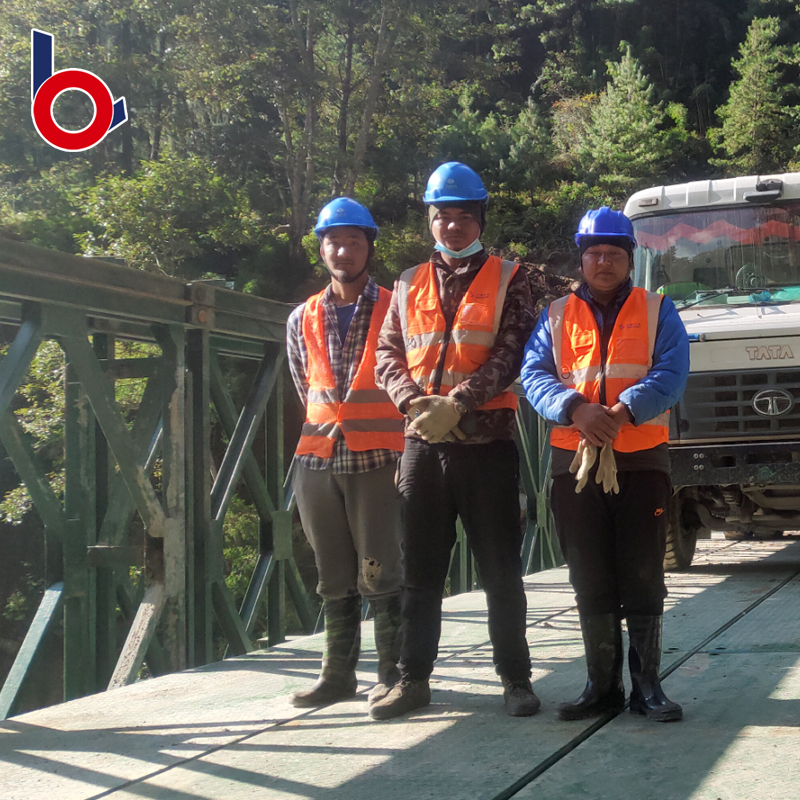
The system stands out due to its modular ingenuity. It represents an advanced evolution of the classic Bailey bridge design. Early Bailey bridges won wars through rapid deployment. Today, modern engineering transforms that legacy into a commercial powerhouse. Engineers rely on standardized 3m x 1.5m welded steel panels. These panels form the core superstructure. They pin together quickly to create robust load-bearing trusses. Precision robotics weld these steel panels to exact tolerances. This ensures every pin slides perfectly into place on site. You do not have to drill or modify components in the field.
Configuration logic depends heavily on your specific span. It also depends on expected shear forces. You do not just build one standard size. Engineers calculate the necessary chord reinforcements. They design multi-row or multi-tier panel configurations. A double-row, single-tier setup handles moderate loads effectively. A triple-row, double-tier setup easily supports massive off-highway dump trucks.
Material integrity guarantees survival under continuous traffic. Manufacturers specify high-yield structural steel. This resists fatigue under heavy dynamic loads. Precise pin-joint mechanics ensure stress distributes evenly across the truss. Hot-dip galvanization protects the steel from highly corrosive environments.
Bridge Component Specifications Table
Component | Material Standard | Primary Function |
|---|---|---|
Main Panels | High-yield structural steel | Resist bending and shear forces |
Connecting Pins | Alloy steel | Transfer loads between panels safely |
Deck Plates | Anti-skid orthotropic steel | Distribute axle loads to transoms |
Surface Treatment | Hot-dip galvanized | Prevent rust and environmental corrosion |
Remote sites present diverse bridging obstacles. You might face a wide, fast-flowing river crossing. Alternatively, you might only need a short-span portable ditch bridge to grant pipeline access. The modular nature of these components accommodates both extremes perfectly. You scale the structural configuration to match your topography.
Safe deployment heavily relies on proper foundation assumptions. The bridge superstructure assembles rapidly. However, you cannot ignore abutment requirements. Safe deployment demands properly compacted sills. Many projects utilize gabion baskets or precast concrete bearing pads. These structural elements transfer the immense load safely into the ground. A bridge is only as strong as its foundation.
You must evaluate span-to-load ratios realistically. Span length directly dictates maximum vehicle weight. Blanket claims of unlimited capacity are dangerous and false. A 20-meter span easily carries heavy crawler cranes. If you stretch that exact same configuration to 40 meters, the load capacity drops significantly. You must consult engineering load charts. Match your configurations to your heaviest vehicle axles.
Transport logistics define the success of remote infrastructure. Transporting massive concrete beams requires specialized logistical planning. You avoid all that complexity with modular steel. Disassembled modular components boast a highly compact footprint. You load them onto standard flatbed trucks easily. This bypasses the need for specialized heavy haulers entirely. Navigating narrow, unimproved logging roads becomes feasible. Flatbeds maneuver easily through tight switchbacks. They navigate steep grades without bottoming out. You eliminate oversized-load permits and expensive pilot cars. Once on site, unloading takes mere hours.
Assembly methods vary based on your specific site constraints. We generally see two primary approaches deployed in the field.
Cantilever Launching: You build the bridge on one bank. You attach a lightweight launching nose to the front. Crews use counterweights and rollers to push the structure across the gap. You do not need any in-water equipment.
Crane-Assisted Lift: Sometimes you have local crane access. Cranes lift pre-assembled truss sections directly into place. This method proves incredibly fast if ground conditions permit crane outrigger deployment.
Labor requirements remain straightforward but demand competence. You need a relatively small crew. Proper alignment prevents mechanical binding. Pin-driving and torqueing require strict adherence to engineering manuals. Competent supervision ensures the crew avoids costly mistakes during rollout.
Safety and compliance govern every temporary crossing. These structures align strictly with AASHTO, Eurocode, or local heavy civil standards. Local municipalities increasingly scrutinize temporary construction access. They demand stamped engineering drawings before issuing permits. Compliant modular bridges simplify this approval process. You hand the inspector a certified load rating document. This eliminates regulatory friction. You avoid costly stop-work orders. You must also verify certified manufacturing processes before procurement. ISO standards and rigorous non-destructive weld inspections guarantee structural reliability. You cannot gamble on substandard fabrication when supporting 80-ton vehicles.
Maintenance realities require proactive attention during operation. You must outline required inspection intervals. Crews should routinely check pin retention clips. They must monitor deck plate wear from tracked equipment. They also need to inspect foundation settlement after heavy rainfall. Early detection prevents minor issues from becoming catastrophic failures.
Financial evaluation favors reusable modular systems. Compare the upfront procurement cost against alternative sunk costs. Building a temporary rock-fill road consumes massive resources. Custom timber bridges cannot be reused easily. Modular steel bridges offer financial predictability. You transition the asset from one phase to the next. This maximizes your operational budget without wasting capital on single-use infrastructure.
Project managers need a clear shortlisting logic. You can use a binary checklist to determine project fit quickly.
Modular Bridge Suitability Chart
Project Scenario | Suitability | Reasoning |
|---|---|---|
Spans over 10 meters | Best Fit | Modular trusses scale easily to cross wide gaps without intermediate piers. |
Heavy machinery loads | Best Fit | Engineered to handle cranes, excavators, and HS20/HL93 load classes safely. |
Difficult transport access | Best Fit | Standard flatbeds can deliver components via narrow, winding rural roads. |
High reusability demands | Best Fit | Pin-joint design allows total recovery for future project deployments. |
Permanent public highways | Poor Fit | Public roads often require complex aesthetics or extreme long-span suspension. |
Once you confirm suitability, focus on the next steps. You must collect accurate site data immediately. Gather geotechnical soil reports for the abutment zones. Measure the exact gap distance carefully. Calculate the maximum vehicle axle weights expected on site. Secure this specific data before engaging a bridge engineer or manufacturer.
Remote site access requires predictable, scalable infrastructure. You cannot leave critical mobilization timelines to chance. Weather windows close rapidly in remote environments. Modular spans remove the guesswork from crossing challenging terrain. They provide a sturdy, reliable path for your heaviest equipment.
The Compact 321 serves as a highly engineered risk-mitigation tool. Project managers focused on timeline security rely on it daily. It replaces unpredictable dirt work with mathematical certainty.
Do not let a difficult river crossing stall your next remote build. Collect your site data today. Request a site-specific load configuration analysis. Consult modular bridge engineering experts to secure your heavy-haul access route.
A: The typical maximum single span reaches around 50 to 60 meters. This depends heavily on the required load class. If your project demands longer distances, engineers must design intermediate piers to support continuous multi-span configurations safely.
A: Yes, crews frequently install these bridges without cranes. They use a cantilever launching method. Workers assemble the bridge on rollers. They attach a lightweight launching nose and push the structure across the gap using counterweights and heavy vehicles.
A: A trained crew typically requires a few days to a week to assemble a standard construction access bridge. This baseline focuses entirely on the superstructure assembly. It explicitly excludes the time required for abutment preparation and earthwork.
A: Yes, these systems offer total reusability. The modular pin-joint design allows crews to completely disassemble the structure. You can easily reconfigure the panels for different spans and varying load requirements at future project sites.
