Tel: +86 15262904857 E-mail: overseas@jsbaileybridge.com
- All
- Product Name
- Product Keyword
- Product Model
- Product Summary
- Product Description
- Multi Field Search


Views: 0 Author: Site Editor Publish Time: 2026-06-30 Origin: Site


Emergency road recovery demands a careful balance between immediate deployment speed and reliable structural integrity. When floods, landslides, or sudden structural failures sever critical transportation routes, decision-makers cannot afford procurement delays or mismatched specifications. The pressure to restore access quickly often leads to hasty engineering choices. This approach can easily put emergency responders and local communities at further risk. We focus here on the Compact 321 Bailey Bridge. We introduce it as a globally standardized and highly adaptable temporary steel truss bridge system designed precisely for these critical moments.
Our objective is to provide engineering and procurement teams with a strict, evidence-based framework. You will learn how to properly evaluate site conditions, size the required components, and source a reliable 321 system for disaster relief scenarios. Applying these technical insights ensures rapid road network restoration without ever compromising on safety or regulatory compliance.
Rapid Deployment: The Compact 321 system is engineered for manual or light-machinery assembly, making it optimal for disaster zones with compromised heavy-equipment access.
Modular Scalability: Load capacity and span length are dictated by panel configurations (e.g., Single-Single to Double-Triple), requiring precise alignment with anticipated emergency traffic (e.g., HS15 to HS20 loads).
Geotechnical Prerequisites: Accelerated bridge construction still requires verified abutment stability; the speed of the superstructure assembly is irrelevant if substructure engineering is ignored.
Procurement Verification: Sourcing must prioritize component interchangeability, high-yield steel grades (e.g., Q345/Q355), and strict manufacturing tolerances to prevent on-site assembly failures.
Before deploying any bridge system, engineering teams must evaluate the physical constraints of the disaster site. Accurate preliminary measurements prevent costly delays during the assembly phase.
First, you must define the physical gap. Accurately measuring the clear span is only the first step. You must also calculate the required launching space on the staging side. The cantilever launching method requires sufficient rear clearance to assemble the bridge panels and attach the counterweights before pushing the structure across the river or ravine.
We recommend following a strict sequence for site assessment:
Measure the precise clear span between stable banks.
Calculate the available flat staging area behind the near abutment.
Identify overhead obstructions like power lines or tree canopies.
Evaluate the approach road grading for heavy transport vehicles.
Post-disaster abutment integrity presents another major challenge. Floods and landslides often cause severe soil washouts. You must carefully assess bank stability before placing loads near the edge. Accelerated bridge construction demands verified substructure support. You cannot safely launch a bridge onto compromised mud. We highly recommend installing temporary foundations before the bridge arrives. Typical solutions include timber mats, concrete sills, or driven micropiles.
Clearance and width limitations also dictate feasibility. The standard single-lane clear width of the 321 system is typically 3.7 meters. You must evaluate if this width meets the specific traffic volume requirements for your recovery operation. Narrow lanes restrict two-way traffic, requiring traffic control systems on either side of the crossing.
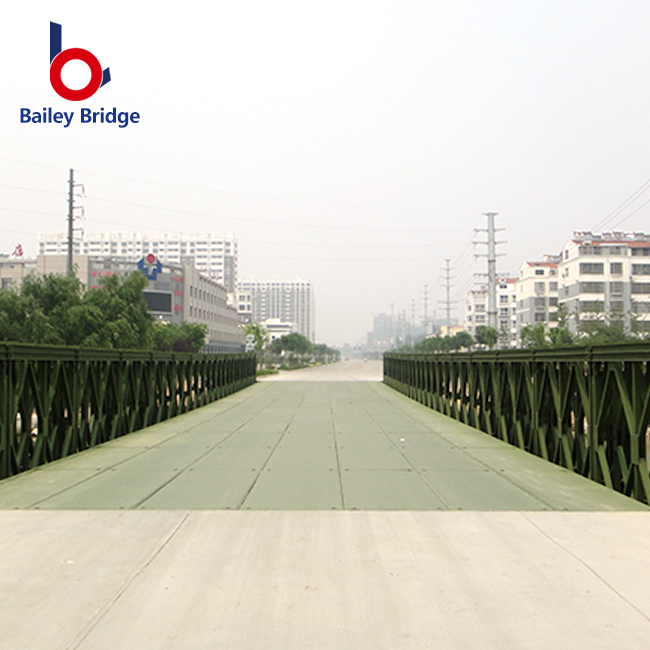
Decision-makers often weigh the 321 design against heavier modular systems. Understanding component weight and handling capacity is crucial for emergency logistics. Standard 321 panels weigh approximately 270 kilograms. This lightweight design allows for manual assembly by a moderately sized crew. When collapsed roads prevent cranes from reaching the site, this manual handling capability becomes a vital asset.
By contrast, heavier systems like the HD200 demand heavy machinery for installation. While the 321 model excels in rapid, standard emergency spans, we must transparently note the trade-offs. You might require an HD200 system for continuous heavy freight operations. Wider dual-lane requirements also push engineers toward heavier truss configurations.
Identifying the appropriate use cases simplifies the selection process. Deploying an emergency Bailey bridge based on the 321 design provides the fastest recovery timeline in specific scenarios. It is ideal for rural access roads, washed-out secondary highways, and immediate disaster relief corridors. When heavy equipment access is impossible, the 321 system offers the most reliable structural solution.
The brilliance of a modular truss system lies in its scalable engineering. You can adapt the bridge to handle varying spans and vehicle weights by simply changing how you assemble the standard panels.
Decoding the truss configurations requires understanding rows and tiers. Adding truss rows side-by-side increases strength. Stacking tiers vertically increases stiffness and span capability. A Single-Single configuration uses one truss row and one tier. It suits short spans and light vehicles. A Double-Single setup places two panels side-by-side on each side of the deck. For longer reaches, you might utilize a Triple-Double arrangement, featuring three parallel rows stacked two tiers high. This exponentially increases both load-bearing capacity and maximum span reach.
Engineers must evaluate deflection limits and fatigue behavior. Moving vehicles impart dynamic live loads onto the superstructure. We advise referencing general AASHTO or FHWA principles for temporary prefabricated structures. These standards govern acceptable deflection ratios under heavy live loads. Proper configuration ensures the bridge absorbs stress safely without risking long-term fatigue failure.
Choosing the right decking material impacts both deployment speed and maintenance.
We compare the two primary options below:
Decking Type | Weight Impact | Installation Speed | Durability & Maintenance | Best For |
|---|---|---|---|---|
Orthotropic Steel Decks | Lighter overall system weight | Extremely fast (drops into place) | High durability, low maintenance | Rapid emergency deployment |
Timber Decking | Heavier, variable weight | Slower manual installation | Prone to rot, higher maintenance | Strict budgets, local sourcing |
Orthotropic steel decks offer superior performance in emergency contexts. They integrate seamlessly with the Compact 321 Bailey Bridge system. While timber is cheaper and locally sourceable, it struggles under continuous wet weather and heavy truck braking forces.
Moving a bridge from a warehouse to a remote disaster zone requires meticulous logistics planning. Modular systems boast an impressively efficient shipping footprint. You can easily pack the components for a typical 30-meter span into just a few standard 20-foot or 40-foot shipping containers. Alternatively, you can transport them using standard flatbed trucks. This minimizes the convoy size traveling into restricted disaster zones.
The standard cantilever launching method eliminates the need for in-water falsework. Crews assemble the bridge on the staging bank. They attach a lightweight "launching nose" to the front of the structure. The team then pushes the bridge forward over specialized launching rollers. You must perform rigorous counterweight calculations before pushing. If the rear of the bridge lacks sufficient weight, the entire structure will tip forward into the gap.
Even with standard systems, rollout bottlenecks occur frequently. You can avoid delays by anticipating these common risks:
Inadequate staging area: Failing to secure enough flat space behind the abutment prevents proper panel assembly and counterweight placement.
Missing connection pins: Transport vibrations can loosen improperly secured hardware. Missing pins halt the entire launching sequence immediately.
Lack of skilled supervision: Underestimating the need for trained oversight often leads to misaligned panels and unsafe launching procedures.
Sourcing structural steel for emergency infrastructure leaves no room for compromise. Procurement teams must enforce strict quality controls when evaluating potential bridge manufacturers.
Material grade verification serves as your primary safeguard. You must demand verifiable mill test certificates for all steel components. High-yield steel grades, such as Q345 or Q355, are non-negotiable for load-bearing truss panels. These documents prove the steel meets minimum yield strength requirements. Without them, you risk catastrophic structural failure under heavy traffic.
Corrosion protection directly influences the lifespan of the deployment. You must evaluate surface treatments based on the expected duration of the bridge's use. Hot-dip galvanizing offers superior, long-lasting protection against rust and harsh weather. It is ideal if the temporary bridge will remain in place for years. Industrial painting provides adequate protection for short-term fixes but requires ongoing maintenance in humid environments.
Finally, component interchangeability guarantees smooth on-site assembly. Buying from unverified manufacturers carries massive risks. If pinholes do not align perfectly under stress, your crew cannot connect the panels. We strongly recommend requiring comprehensive trial assembly reports before the manufacturer ships the final product. This ensures precision manufacturing tolerances are met.
Selecting a modular steel truss system significantly reduces disaster recovery timelines, but only when executed correctly. Speed relies entirely on rigorous site assessment, accurate configuration sizing, and uncompromising quality procurement. You cannot bypass basic engineering principles just because the situation is an emergency.
We advise procurement and engineering teams to finalize their required clear span and anticipated load class first. You must complete thorough geotechnical surveys of the post-disaster abutments. Once you gather this critical site data, you can confidently request highly specific technical drawings and firm quotes from reputable bridge manufacturers.
A: The maximum un-piered span depends heavily on the chosen load class and panel configuration. For lighter loads, a heavily reinforced Triple-Double configuration can reach up to 51 to 60 meters. However, spans decrease significantly for heavy continuous truck traffic. Every configuration must be engineer-approved for the specific site.
A: Yes. The 321 system is completely modular and dismantle-friendly. Once the permanent bridge opens, crews can easily unpin the panels and disassemble the structure. Governments and contractors often store these components in their inventory for rapid deployment during future disaster responses.
A: Installation usually takes a few days, not hours. This timeframe assumes you have pre-staged components, a trained crew of 10 to 15 people, and pre-prepared abutments. Foundation and earthwork usually serve as the primary pacing items. The actual superstructure assembly is incredibly fast once the site is ready.
