

Views: 0 Author: Site Editor Publish Time: 2026-07-05 Origin: Site


Infrastructure projects constantly face a persistent friction. You must balance strict compliance and heavy load requirements against aggressive timelines and tight budgets. Traditional custom-built structures often fall short here. They face prolonged engineering cycles and endure severe weather-delayed construction. Conversely, relying on inferior temporary structures creates unacceptable safety and regulatory risks. Project planners desperately need a reliable middle ground. This guide provides an objective, engineering-focused framework. It helps contractors evaluate whether a Compact 321 bridge system fits specific site conditions. You will discover how to align structural capabilities with your exact load demands and deployment schedules. We explore component configurations, engineering compliance, and real-world assembly logistics. By the end, you will understand exactly when and how to deploy this modular solution effectively. You can then confidently accelerate your next crossing project.
The Compact 321 bridge system offers a standardized, modular alternative to custom builds, significantly compressing project timelines for both temporary detours and permanent rural access.
Evaluating feasibility requires mapping specific span lengths and load ratings (e.g., HL-93) against the limitations of a prefabricated bridge structure.
Successful implementation hinges on site preparation, specifically abutment design and assembly staging area availability, rather than complex on-site fabrication.
Procurement decisions should weigh total cost of ownership (TCO)—including logistics, assembly crew size, and residual asset value—against traditional construction methods.
You can view this system as an advanced iteration of the traditional Bailey bridge design. It utilizes standardized 3-meter (10-foot) long welded steel panels. These modular units form the primary load-bearing trusses. Engineers designed them for rapid transport and straightforward assembly. This framework eliminates custom steel fabrication delays.
The core components are simple but highly engineered. You assemble transom beams, stringers, and modular decking to form the roadway. The decking options typically include durable steel orthotropic plates or heavy timber. A key advantage lies in the pin-jointed connections. You secure panels using specialized high-tensile pins. This approach eliminates the need for on-site welding. It also removes specialized fastening procedures from your critical path.
Understanding the "321" nomenclature is crucial for project modeling. The numbers describe how you arrange the panels to increase strength. You adjust panels per truss, the number of vertical tiers, and the vertical storeys. Configuring these variables directly impacts maximum span and load-bearing capacity.
Configuration Type |
Truss Layout |
Best Application |
Relative Load Capacity |
|---|---|---|---|
Single-Single (SS) |
One panel wide, one tier high |
Short spans, pedestrian, light vehicles |
Base Capacity |
Double-Single (DS) |
Two panels wide, one tier high |
Medium spans, standard highway loads |
Moderate |
Triple-Single (TS) |
Three panels wide, one tier high |
Longer spans, heavy commercial traffic |
High |
Double-Double (DD) |
Two panels wide, two tiers high |
Extended spans, extreme heavy haul |
Very High |
We must maintain an objective engineering perspective. Modularity guarantees rapid assembly, but it does not bypass basic physics. You must still model the structural rigidity against project-specific dynamic loads. Deflection limits and wind loads require careful calculation. A modular system is highly adaptable, but proper engineering oversight remains mandatory.
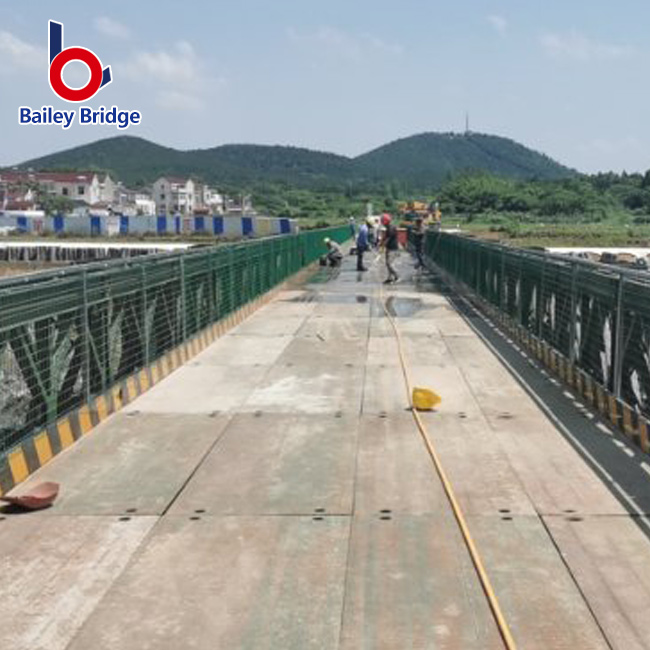
Every bridge type has a defined operational sweet spot. You must identify whether your site aligns with this system's strengths. We see the highest success rates across three specific scenarios. First, emergency disaster relief demands rapid infrastructure recovery. Washouts and collapsed spans require immediate replacement. Second, heavy-haul detour bridges keep traffic moving during DOT highway construction phasing. Finally, logging, mining, and remote resource extraction operations need robust access roads quickly.
To build trust with stakeholders, you must understand the limitations. State clearly where this system is not optimal. You will face disqualifiers in certain environments.
Highly curved alignments: These structures are inherently linear. Extreme horizontal curves require complex custom engineering.
Extreme long-span requirements: Spans exceeding maximum limits without intermediate piers will fail deflection criteria.
Architecturally sensitive urban environments: The industrial steel truss aesthetic may clash with strict city design mandates.
You must frame the decision around cost-to-outcome metrics. Compare the predictable, fixed material costs of a prefabricated bridge structure against variable alternatives. Cast-in-place concrete involves unpredictable labor expenses. Custom steel girders suffer from volatile market pricing and fabrication delays. The modular system locks in your material costs early. You also drastically reduce variable labor hours. This predictability helps contractors protect their profit margins.
Meeting standard highway load requirements is non-negotiable. You must approach design calculations using established load rating frameworks. North American projects typically rely on AASHTO LRFD standards. You will model for HL-93 design loads to ensure heavy truck compliance. Regional DOT equivalents dictate similar rigorous checks. You calculate shear, bending moments, and acceptable deflection limits based on the exact panel configuration chosen.
Evaluating fatigue and durability requires defining the structure's lifespan. Temporary detour applications have different fatigue limits than permanent installations. You must evaluate the steel grade carefully. High-yield steel handles repeated cyclical loading better. For long-term durability, you need proper corrosion resistance. Hot-dip galvanization provides superior protection over time compared to basic enamel paint.
Superstructure assembly speed is completely irrelevant if your substructure is poorly planned. You must establish firm ground before launching.
Abutment Design: Engineer solid concrete or gabion abutments capable of handling concentrated end reactions.
Bearing Pads: Install precise elastomeric or steel bearing pads. They distribute the load and accommodate thermal expansion.
Soil Compaction: Achieve specified compaction rates behind the abutments. This prevents settlement under heavy braking loads.
Securing compliance documentation is the final hurdle. You need manufacturer-provided engineering drawings. Local regulatory reviews typically require a third-party PE (Professional Engineer) stamp. Do not skip this step. The PE stamp validates your configuration against local seismic, wind, and live load codes.
Your site layout dictates your assembly method. The "cantilever launch" method is highly popular. You assemble the structure on one bank and literally push it across the gap. This method requires a specific staging area prerequisite. You need a flat, compacted approach path at least as long as the bridge itself. Alternatively, you can use crane-assisted placement. This requires less linear space but demands a stable pad for heavy mobile cranes.
Contractors often worry about equipment and crew capabilities. You do not need a highly specialized bridge-building crew. Standard civil contracting crews can execute the assembly efficiently. They usually work alongside a manufacturer’s technical advisor on-site. Standard machinery handles the bulk of the work. You need rocking rollers, launching noses, and standard excavators or small cranes to lift individual panels.
Risk mitigation happens in the project planning phase. You must anticipate common deployment bottlenecks to keep the schedule intact.
Uneven launch planes: A slight slope can cause the structure to bind during a cantilever push. Grade the staging area perfectly flat.
Misaligned rollers: If rocking rollers are not perfectly parallel, the truss will drift off-center. Survey roller placement accurately.
Improper pin sequencing: Inserting pins out of order creates immense friction. Follow the technical advisor's exact sequence.
Deciding between leasing and purchasing fundamentally shapes your strategy. Renting the bridge makes sense for temporary detours under 24 months. You avoid storing the asset afterward. Purchasing is better for permanent installations. It also suits contractors who want to standardize an internal fleet for repeated deployments. Evaluate your project pipeline before deciding.
You must apply strict shortlisting logic to vendors. What should you demand from a supplier before signing? First, require verifiable material origin and mill test certificates. These documents are absolutely crucial for DOT projects. They prove the steel meets structural standards. Second, confirm the availability of on-site technical assistance. Having an expert during the initial launch prevents costly mistakes. Third, confirm precise lead times and freight logistics to remote sites. A stranded delivery truck ruins your aggressive timeline.
Your next steps require precise field data. Advise your planners to prepare thorough geotechnical reports. You also need precise topographical surveys. Send this data before requesting vendor quotes. Accurate site information ensures the vendor models the exact panel configuration you actually need.
The Compact 321 system effectively bridges the critical gap between engineering rigor and deployment speed. You achieve rapid installation without sacrificing structural integrity. However, this success assumes you accurately model the site conditions and load configurations beforehand.
We strongly recommend integrating prefabricated structural evaluation early. Do it in the conceptual design phase rather than as a reactive measure. Proactive planning eliminates rushed engineering approvals. It ensures your substructure is ready when the steel panels arrive.
Take action on your next crossing project today. Submit your required span, target load requirements, and specific site constraints to a qualified supplier. Request a structural feasibility review or a detailed technical specification sheet. This single step will clarify your project timeline and solidify your procurement strategy.
A: Standard engineering limits typically allow spans up to 60 meters (approximately 200 feet). This depends heavily on the required load class and the specific truss configuration used. If you need to cross wider gaps, intermediate piers become necessary to support multiple continuous or distinct spans safely.
A: Yes, it can. The structure must meet specific AASHTO LRFD design criteria for permanent applications. It also requires appropriate anti-skid steel decking for daily traffic. Furthermore, the steel components must feature long-term corrosion protection, typically achieved through high-quality hot-dip galvanizing.
A: Infrastructure costs remain highly variable. While raw material costs might appear comparable initially, the financial advantage comes from labor reduction. You typically see a 60% to 80% reduction in on-site labor hours. The minimal need for heavy machinery and custom forming also drives significant operational savings.
A: You should set realistic expectations. Off-the-shelf components can often mobilize and ship within weeks. However, the actual critical path is dictated by local site preparation and engineering approvals. Securing PE-stamped drawing approvals and curing concrete abutments usually take longer than acquiring the steel itself.
