

Views: 0 Author: Site Editor Publish Time: 2026-07-31 Origin: Site


Calculating structural weight goes far beyond a basic physics equation. Accurate dead load assessment acts as the foundational metric for structural engineering. It heavily dictates project feasibility, foundation expenses, and overall structural longevity. Engineers and project managers rely on these exact figures to ensure safe, viable infrastructure. Imprecise dead load estimation introduces severe physical and financial risks. You face accelerated structural fatigue, regulatory non-compliance, and potentially catastrophic failure scenarios. Furthermore, over-engineering to compensate for this mathematical uncertainty frequently causes massive budget bloat. Moving from theoretical load models to practical field implementation takes careful planning. We must rigorously evaluate specific materials, intended lifespans, and distinct structural configurations. You will soon discover how evaluating standard infrastructure against modular solutions significantly shapes your ultimate project success.
Dead load represents the constant, static weight of the truss bridge infrastructure itself, fundamentally dictating foundation requirements and maximum live load capacity.
Accurate calculation methodologies must account for all structural members, decking, and long-term modifications, aligning with AASHTO or ASCE compliance standards.
Advanced monitoring technologies and deconstruction data provide evidence-based insights to update dead load assumptions in aging infrastructure.
Choosing between permanent heavy-steel structures and modular solutions (like a bailey truss bridge) hinges on balancing initial dead load constraints against deployment speed and project ROI.
Every engineering project begins by establishing clear physical constraints. We define dead load strictly as the intrinsic, immovable weight of the structure itself. This encompasses the primary structural skeleton, including heavy steel girders, top and bottom chords, and diagonal struts. It also includes the decking surface, concrete slabs, railings, and any permanent lighting fixtures attached to the span. These elements remain constantly in place. They never move, and their downward gravitational force never ceases.
You must clearly separate this concept from dynamic forces. Engineers contrast the constant, static nature of dead load with the highly variable nature of live loads. We can categorize these distinct forces to establish precise baseline terminology:
Dead Load: The permanent, unyielding weight of structural materials. It remains constant from the moment crews finish assembly.
Live Load: The transient forces moving across the span. This includes commercial traffic, pedestrian crowds, and heavy transport vehicles.
Environmental Load: Unpredictable dynamic forces caused by external elements. We include hurricane-force winds, snow accumulation, and severe seismic activity in this group.
A well-designed truss bridge excels at managing these intense static forces. It distributes its immense dead weight through a series of interconnected triangles. This geometric arrangement channels downward gravitational forces laterally along the chords. It eventually pushes the weight down into the solid abutments and massive concrete piers. This triangular distribution maximizes spanning capabilities. It effectively carries massive weight while minimizing excess material usage across the central void.
Translating structural concepts into safe infrastructure requires rigorous mathematics. We rely on a standardized engineering framework to determine exact static weights. The sequential logic of load calculation involves multiplying known material densities by their total physical volume. Engineers then add the calculated weight of all permanent non-structural attachments. This process leaves no bolt or gusset plate unaccounted for.
We execute this calculation model through a highly systematic sequence:
Volumetric Assessment: Draftsmen calculate the exact volume of all steel beams, cross-members, and deck slabs using advanced CAD software.
Density Multiplication: Engineers apply the specific density values of chosen materials. They multiply the volume by these weights to find the baseline component mass.
Connection Allowances: Designers add a percentage-based allowance for connecting elements. They factor in thousands of heavy steel bolts, thick gusset plates, and heavy weld metal.
Fixture Integration: The team adds the static weight of non-structural elements. This step includes safety barriers, asphalt layers, and permanent utility conduits.
Several key variables heavily influence the final mathematical figure. Span length serves as the most critical factor. As the distance between piers increases, the structural self-weight increases exponentially. Material selection also plays a massive role. You might choose high-strength structural steel for ultimate durability, or you might select advanced aluminum alloys to intentionally slash the baseline weight. Connection types also alter the math. A heavily bolted connection utilizes bulky gusset plates, adding far more dead mass than streamlined welded joints.
Civil engineering regulatory bodies demand absolute precision. Organizations like ASCE (American Society of Civil Engineers) and AASHTO (American Association of State Highway and Transportation Officials) mandate strict compliance standards. They require designers to apply standardized load factors. For example, engineers might multiply the calculated dead weight by a factor of 1.25. This safety margin accounts for unexpected material density variances. It covers slight manufacturing tolerances and guarantees structural integrity under worst-case scenarios.
Project managers face critical decisions regarding span architecture. We typically separate solution categories into two distinct groups. You can choose traditional, heavy-civil truss installations, or you can leverage modular, temporary, or semi-permanent solutions. Heavy-civil projects utilize massive, custom-fabricated steel girders. They require years of planning, massive budgets, and deep bedrock foundations to support their immense self-weight.
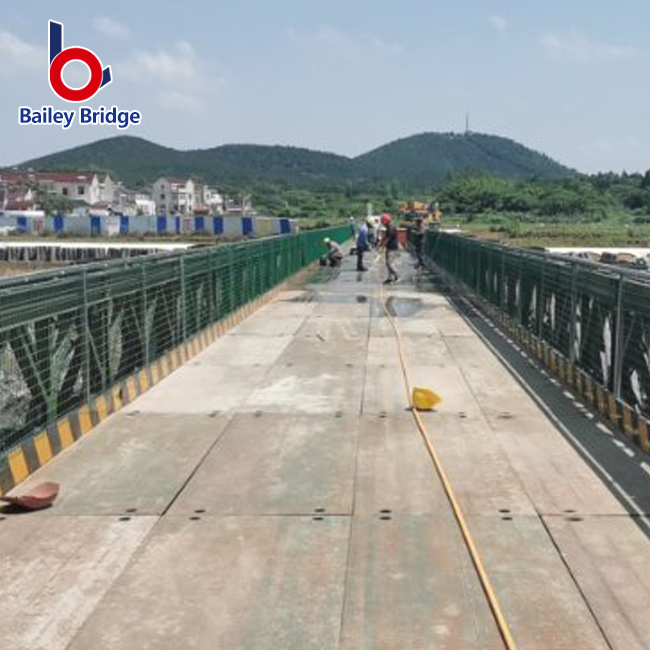
Modular solutions disrupt this slow, heavy paradigm. The bailey truss bridge stands as a prime example of engineered efficiency. Engineers originally designed this system for rapid military deployment. It utilizes standardized, lightweight panels pinned together in repeatable patterns. This brilliant modularity significantly reduces the baseline dead load. Manufacturers pre-fabricate these elements from high-yield steel, maximizing strength while ruthlessly shedding unnecessary bulk.
This massive reduction in intrinsic weight triggers a cascade of positive project outcomes. We can map these specific features directly to operational benefits. A lower baseline weight translates immediately into rapid field deployment. Crews maneuver lightweight panels using standard equipment. They completely bypass the need for massive, specialized heavy-lifting cranes. Furthermore, lower intrinsic mass allows engineers to utilize existing, older abutments. They can even deploy minimal temporary foundations in emergency scenarios or remote geographical locations.
Evaluation Criteria |
Traditional Heavy-Civil Structure |
Modular Bailey Truss Structure |
|---|---|---|
Baseline Dead Load |
Extremely high. Requires massive foundational support. |
Significantly optimized. Utilizes lightweight pinned panels. |
Deployment Speed |
Slow. Often takes months or years to fully assemble. |
Rapid. Crews can launch sections in days or weeks. |
Equipment Needs |
Requires highly specialized, ultra-heavy lifting cranes. |
Requires only standard excavators or small mobile cranes. |
Geotechnical Impact |
Demands deep pile driving and massive concrete footings. |
Adaptable to shallow footings or pre-existing abutments. |
Theoretical engineering models rarely match field realities perfectly. We constantly address the gap between the theoretical design load and the actual "as-built" weight. Real-world implementation risks introduce unexpected static forces. Construction crews often apply excess welding material beyond specified minimums. They might execute unrecorded field modifications to solve alignment issues. Furthermore, paint layers and protective anti-corrosion coatings add thousands of unexpected pounds over long spans.
You must also recognize that intrinsic weight never remains entirely static across decades. Dead load frequently increases over time due to operational changes and lifecycle events. Maintenance departments often execute structural retrofitting. They bolt on additional steel reinforcement plates to aging members. Highway crews frequently repave deteriorated decking without removing the old layers. Adding just two inches of fresh asphalt across a 300-foot span adds a staggering amount of permanent, unintended downward force. Environmental buildup also plays a role. Decades of accumulated dirt, pigeon guano, and rust expand the baseline mass.
Fortunately, the engineering industry now utilizes advanced evaluation techniques to combat these mysteries. Modern methodologies allow inspectors to scientifically verify actual field loads. Crews install sophisticated structural health monitoring (SHM) systems directly onto steel chords. They utilize electronic strain gauges and fiber optic sensors to read physical stress in real-time. These sensors reveal exactly how much downward force the structure actually supports.
Furthermore, engineers now harvest incredible data gleaned from bridge deconstruction monitoring. When demolition teams take apart historic structures, researchers carefully measure the released physical tension. They weigh the dismantled members to validate historical assumptions. This forensic approach proves that many mid-century structures carry up to 15% more dead mass than their original blueprints claimed.
Physical mass directly dictates financial viability. We see a harsh, unbreakable correlation between dead load mass and geotechnical requirements. Higher baseline weight requires significantly deeper, more expensive foundations. When a span carries enormous intrinsic mass, engineers must drive steel piles much deeper into the earth to find refusal. They must pour exponentially larger concrete pier caps. These foundation economics often consume the largest portion of initial infrastructure budgets. Managing the span's self-weight directly controls these massive capital outlays.
The logistics and procurement phases also feel the heavy impact of structural weight. Evaluating the dead weight of individual structural members heavily impacts shipping logistics. Massive steel girders require specialized transport logistics. You must hire specialized multi-axle trailers, arrange police escorts, and secure complex highway permits. This slows down delivery timelines and strains supply chain efficiency. Conversely, modular panels fit easily onto standard flatbed trucks. This simplified logistics chain slashes delivery costs and accelerates site mobilization.
Project managers need a reliable shortlisting logic to navigate these choices. We provide a clear framework for deciding on structural types based on cost-benefit analysis. You must evaluate the dead load implications against your required live load capacity and expected operational lifespan. If you need a monumental span to carry four lanes of heavy interstate traffic for a century, traditional heavy-civil architecture makes sense. However, if you need a rapid, two-lane crossing for a mining operation, rural detour, or emergency relief route, heavy foundations destroy your ROI. In these scenarios, lightweight modular systems offer the only viable path forward.
Accurate evaluation of structural weight goes far beyond basic compliance. Dead load represents the absolute baseline constraint from which all other engineering and financial decisions flow. It dictates the depth of your foundations, the size of your cranes, and the scale of your construction budget. Failing to calculate these forces correctly introduces immense risk to both human safety and project viability.
Balancing uncompromising structural integrity with necessary cost efficiency requires selecting the right truss architecture. You must utilize strict calculation frameworks and employ modern monitoring standards to verify field conditions. Embracing advanced materials and modular geometries allows modern teams to do more with less.
We strongly encourage infrastructure decision-makers to take immediate action. Conduct comprehensive feasibility studies before purchasing materials. Analyze your geotechnical constraints thoroughly. Consult with specialized structural engineering firms before committing to specific permanent or modular deployments. Informed decisions made during the design phase will safeguard your infrastructure for decades to come.
A: Span length directly dictates this ratio. Short spans carry a higher percentage of live load from traffic. As span lengths increase, the structure requires significantly more steel to support itself. Consequently, long-span designs feature a much higher dead-to-live load ratio. Massive structures like cantilevered trusses dedicate most of their capacity to supporting their own immense dead weight.
A: Engineers must manage dead load dynamically during assembly. They utilize cambering, a process of curving beams upward before installation. As workers add deck panels and structural members, the progressively applied weight pushes the span down into a level position. Crews also rely on temporary shoring and strategic staging. They sequence member installation to prevent unbalanced force distribution.
A: Yes, engineers frequently reduce existing dead loads through targeted retrofitting. They often remove heavy reinforced concrete decks. Crews then install lightweight grid decking or fiber-reinforced polymer panels. This strategy removes significant unnecessary weight. It frees up structural capacity, allowing older spans to safely accommodate heavier modern traffic without requiring complete structural replacement.
