Tel: +86 15262904857 E-mail: overseas@jsbaileybridge.com
- All
- Product Name
- Product Keyword
- Product Model
- Product Summary
- Product Description
- Multi Field Search


Views: 0 Author: Site Editor Publish Time: 2026-07-25 Origin: Site


Moving from structural theory to physical execution demands careful planning. You must understand how a truss bridge is constructed to succeed. This knowledge helps project managers, municipal planners, and developers accurately assess site feasibility. It also helps you project realistic deployment timelines. Modern bridge assembly relies heavily on precision manufacturing. Site-specific logistical planning plays a massive role in day-to-day progress. The entire process goes far beyond basic mechanics.
We will break down the end-to-end construction process here. You will learn key evaluation criteria for different assembly methods. We also outline practical implementation realities faced by contractors on the ground. By understanding these phases, you can ensure smoother project execution. Poor site preparation often causes severe delays. We help you avoid those common pitfalls early.
Site readiness dictates the timeline: Geotechnical stability and abutment construction often require more time than the actual steel assembly.
Assembly methods vary by terrain: Contractors choose between crane-assisted lifting, falsework support, or cantilever launching based on the obstacle below.
Modular systems accelerate deployment: Standardized solutions, like the bailey truss bridge, bypass lengthy custom fabrication phases and drastically reduce on-site labor requirements.
Precision is non-negotiable: Effective construction requires strict tolerance management during the bolting and pinning of nodes to ensure load-bearing integrity.
A bridge is only as reliable as its foundation. Poor site assessment directly causes budget overruns and delayed timelines. Planners often underestimate the complexity of bank stabilization. They rush into structural orders before confirming soil conditions.
Geotechnical surveys form the baseline of your project. Crews perform detailed drilling and soil testing. These tests determine the necessary depth and type of foundational piles. Soft clay requires deep friction piles. Solid bedrock might only need surface-anchored spread footings. You cannot finalize engineering blueprints until soil scientists sign off on ground bearing capacity.
Constructing abutments and piers happens next. Workers pour reinforced concrete to create strong structural supports. You must carefully monitor curing timelines. Concrete typically takes weeks to reach its full design strength. You cannot place heavy steel loads on green concrete. This curing phase directly impacts the overall project schedule.
Staging area requirements require equal attention. You must evaluate the necessary square footage on the riverbank. Heavy equipment access and component staging demand substantial flat ground. Teams must organize these logistics logically.
Clear the primary riverbank or gap edge of loose vegetation.
Compact the staging ground to support heavy cranes and delivery trucks.
Establish organized laydown areas for steel chords, verticals, and diagonals.
Build secure temporary access roads for continuous material delivery.
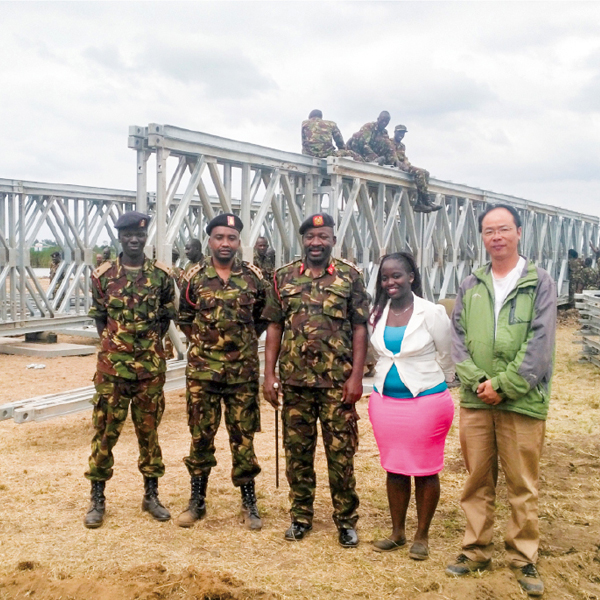
Determining how the steel gets over the gap is your next major hurdle. You must choose an operational model based on strict environmental constraints. Contractors typically select one of three primary deployment methods.
In-situ construction relies on temporary falsework. Crews build temporary scaffolding beneath the bridge path. This scaffolding supports the structure during active assembly. Workers bolt individual pieces together while standing directly over the gap. This method works perfectly for shallow water or solid ground. However, deep ravines make falsework prohibitively expensive.
Crane lifting offers a faster alternative under the right conditions. Teams pre-assemble whole sections on the ground. Sometimes they assemble the entire span nearby. Operators then utilize heavy-lift cranes to set the bridge in place. This strategy heavily reduces dangerous over-water labor. You must carefully assess the logistical limitations of crane access. Massive cranes require exceptionally stable ground and clear swing paths.
Cantilever launching provides a highly specialized alternative. Crews push the assembled bridge across the gap using heavy-duty rollers. They attach a lightweight launching nose to the front. This nose reaches the far bank before the heavier main bridge crosses the center point, preventing tipping. This strategy proves ideal for deep ravines or active waterways. It excels anywhere falsework is impossible.
Bridge Assembly Methods Comparison
Assembly Method | Best Environment | Primary Limitation | Equipment Needs |
|---|---|---|---|
Falsework (In-situ) | Shallow water, dry land | Vulnerable to flood events | Scaffolding, hand tools |
Crane Lifting | Accessible banks, short spans | Requires massive ground stabilization | Heavy-lift cranes |
Cantilever Launching | Deep ravines, busy waterways | Requires extra staging space behind abutment | Rollers, launching nose |
Execution realities on the ground dictate daily progress. Workers must physically join individual triangles on-site. These triangles consist of chords, verticals, and diagonals. Every connection matters.
High-strength bolting or pinning dominates modern construction. Planners heavily favor these methods over field-welding. Bolting provides incredible speed and superior quality control. It guarantees weather independence. A bolting crew can work through light rain. A field welder cannot. Bolting also ensures ease of inspection. Inspectors can easily verify bolt tension using calibrated torque wrenches.
Tolerance management represents a critical requirement. Crews must align nodes perfectly. Small misalignments compound over the length of the span. Engineers implement pre-cambering to solve load issues. They build a slight upward curve into the bridge during manufacturing. This curve compensates for dead load deflection. The bridge settles into a perfectly flat plane once fully unsupported.
Deck installation finalizes the structural phase. You transition from the structural skeleton to the active running surface. Material choices include treated timber, open steel grid, or pre-cast concrete panels. Concrete panels require heavy lifting but offer extreme durability. Open steel grids install quickly and shed snow. Timber provides a lightweight, cost-effective option for rural routes. Your material choice dictates timeline implications and future maintenance needs.
Comparing bespoke bridges with pre-engineered alternatives reveals distinct project paths. Heavily engineered custom structures require lengthy design phases. Planners increasingly pivot toward modular alternatives for rapid deployment.
A bailey truss bridge represents the gold standard of modular design. This system utilizes interchangeable, pre-fabricated steel panels. Crews link these panels rapidly using high-tensile steel pins. Standardized components eliminate the need for complex field measurements. You simply lock the pieces together like an industrial structural kit.
Speed to deployment is the primary advantage. Standardization entirely eliminates custom fabrication lead times. Manufacturers keep panels in stock. You can deploy them immediately. Assembly utilizes standard heavy machinery. In emergency scenarios, manual labor can assemble smaller variations. This flexibility saves months of waiting.
Modular systems offer a highly favorable cost-to-outcome ratio. They make immense financial logic for specific use cases. Temporary access roads and disaster relief sites benefit greatly. Low-to-medium volume rural routes also rely on these structures. Custom spans demand massive upfront capital expenditure. A standardized modular system avoids those steep design and fabrication premiums.
Navigating the friction points that delay construction defines successful risk management. You must proactively manage hidden challenges. Unforeseen environmental regulations and strict testing parameters often stall unprepared teams.
Environmental permitting requires early attention. You must manage the footprint of all construction equipment. Operating near sensitive waterways triggers strict federal and local oversight. Protected habitats demand containment systems to prevent soil or chemical runoff. You must install silt fencing and spill-containment mats before heavy machinery arrives.
Inspection standards safeguard public safety. The industry requires third-party non-destructive testing (NDT) on major connections. Inspectors utilize ultrasonic or magnetic particle testing. These methods identify microscopic flaws inside steel joints. Rigorous load-testing protocols must occur before opening the structure to traffic. Engineers place heavily loaded trucks on the span to measure actual deflection against structural models.
Long-term maintenance planning starts during the design phase. You must design safe access points for future inspections. Walkways and tie-off points protect maintenance crews. Construction choices directly dictate your 50-year maintenance budget. Galvanized steel resists corrosion effectively in wet environments. Weathering steel develops a protective rust patina naturally. You must choose the right surface treatment for your specific climate zone.
Moving from preliminary research to active procurement requires a structured decision framework. You must consolidate your site data into actionable requests for proposals.
Begin by clearly defining the scope. Document your required clear span precisely. Identify your target load rating. Highway traffic typically requires an HL-93 load rating. Outline your lifespan expectations. A temporary mining road has vastly different durability needs than a municipal highway crossing.
Vendor vetting separates reliable partners from risky suppliers. Ask bridge manufacturers specific questions. Request their fabrication certifications (such as AISC certification). Inquire about shipping logistics, especially if you operate in remote sites. Ask about the availability of on-site technical advisors. A vendor should ideally send a representative to guide your local assembly crew.
Initiating the process always starts on the ground. We recommend a professional site survey as your mandatory first step. Do this before requesting localized engineering schematics. Accurate topographic and geotechnical data prevents costly redesigns later. Gather your site data, finalize your load requirements, and begin manufacturer outreach.
Constructing a functional truss bridge remains an exercise in profound logistical precision. The choice of assembly method directly dictates both the project timeline and the budget. You must align your structural design with the physical realities of your job site.
Evaluating site constraints early ensures you make the correct choice. You will easily decide between a custom build or a rapid-deployment modular system once you understand the terrain. Rushing the site evaluation phase always leads to structural complications.
We encourage stakeholders to consult directly with certified structural engineers. Engage modular bridge vendors to assess your specific site requirements. They can provide targeted insights based on load demands and local environmental factors. Take action by scheduling a comprehensive geotechnical survey today.
A: Timelines vary significantly based on the chosen system. A modular bailey truss bridge can be assembled and launched in mere days or weeks. Conversely, custom structures requiring complex concrete abutments and bespoke steel integration usually take several months from site prep to final decking.
A: Yes. Contractors frequently use cantilever launching methods. This technique utilizes rollers and a lightweight launching nose to push the structure across the gap. It is incredibly common in modular setups and eliminates the need for massive heavy-lift cranes.
A: Site preparation usually takes the longest time. Environmental permitting, geotechnical drilling, and the curing time for concrete abutments demand extended periods. The actual physical assembly of the steel superstructure is often much faster.
A: Yes. A common misconception is they only serve as temporary fixes. Modular bridges can serve as highly reliable permanent infrastructure. When manufactured from galvanized steel and properly maintained, they easily support decades of daily traffic.
