Tel: +86 15262904857 E-mail: overseas@jsbaileybridge.com
- All
- Product Name
- Product Keyword
- Product Model
- Product Summary
- Product Description
- Multi Field Search


Views: 0 Author: Site Editor Publish Time: 2026-07-14 Origin: Site


Civil engineers, procurement managers, and disaster relief planners face a critical decision during infrastructure planning. They must select the right modular steel bridge for complex terrain. Choosing between different available systems requires balancing load requirements, span length, budget, and compliance standards. A poor choice often leads to structural inadequacy, serious compliance failures, or unnecessary budget bloat.
Navigating these variables demands reliable data and practical foresight. This article provides a deep technical and commercial comparison to help decision-makers evaluate their options. You will discover how to specify the correct modular bridge system based on objective engineering parameters. We will also explore real-world deployment realities and equipment constraints. Ultimately, you will gain the clarity needed to make a confident, safe, and efficient procurement choice.
The **Compact 200 Bailey Bridge** features a taller truss panel (approx. 2.13m) and thicker steel components, making it the standard for heavy loads, wider spans, and international compliance (AASHTO/Eurocode).
The **Compact 321 bridge** utilizes a shorter panel (approx. 1.4m to 1.5m) and lighter components, ideal for manual or low-equipment installation, shorter spans, and budget-conscious temporary deployments.
Selection should be driven by maximum single-span requirements, expected vehicular load classifications, available lifting equipment on-site, and regional certification requirements.
Engineers must first understand the physical and metallurgical baseline of both systems. These foundational elements dictate structural behavior under stress. They also determine how well the bridge withstands harsh environmental conditions over time.
The core structural unit of any modular bridge is the truss panel. Panel geometry directly dictates the overall strength of the entire system.
Compact 200 Panel: This panel measures 3.048 meters in length and 2.134 meters in height.
Compact 321 Panel: This panel shares a similar length but features a shorter height. It typically measures between 1.4 meters and 1.5 meters tall.
Truss height directly impacts bending moment capacity. A taller truss creates a larger lever arm against vertical loads. The Compact 200 bridge leverages this taller height to resist downward forces effectively. Conversely, the shorter 321 panel offers less bending resistance. It compensates through its lighter weight and easier handling.
Material selection heavily influences both safety and longevity. Manufacturers typically forge these bridges from high-yield structural steel. Common grades include Q345B or Q460 steel. Q345B provides excellent tensile strength for standard applications. Q460 delivers superior yield strength for extreme load cases.
Factory-level quality control matters immensely. Strict welding standards prevent microscopic fractures under repeated stress. High-quality hot-dip galvanization coats the steel in protective zinc. This process actively prevents rust and corrosion. Superior fabrication directly impacts structural longevity. Poor galvanization leads to rapid degradation in humid or coastal environments.
These two systems evolved from different logistical needs. The 200 series evolved specifically for heavy international logistics. Engineers designed it to handle massive commercial payloads. The 321 series evolved from earlier military models. Designers optimized it for rapid, localized deployment. They prioritized mobility over maximum load capacity. Understanding these origins helps you align the product to your specific project goals.
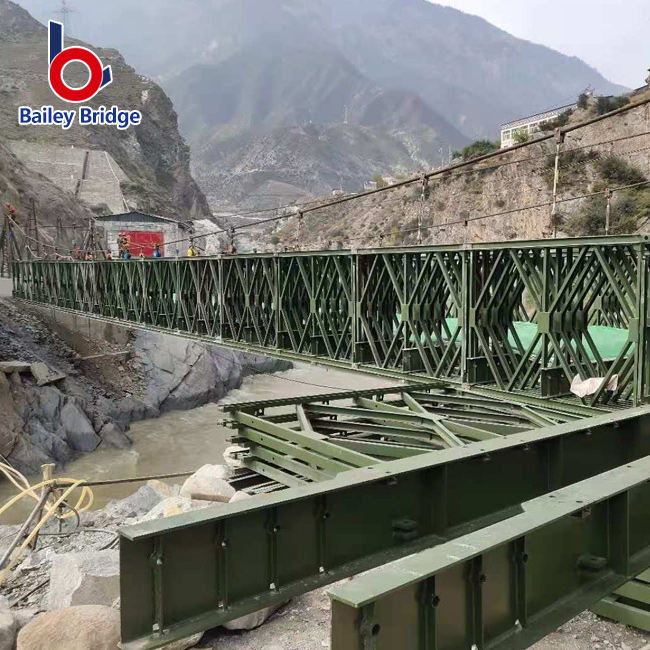
Matching project demands to engineered limits ensures structural integrity. You must evaluate performance limits carefully. Overloading a modular bridge invites catastrophic failure.
The Compact 200 Bailey Bridge excels in heavy-duty applications. It achieves long single spans easily. In certain multi-truss configurations, it spans up to 60 meters unreinforced. It handles heavy multi-axle loads effortlessly. Engineers frequently rate it for HS20, HS25, and HA/HB load classifications. This makes it perfect for mining trucks and heavy freight.
We map out a different operational envelope for the 321 system. It represents standard-duty performance. Procurement teams favor it for shorter spans. It safely supports standard commercial and rural traffic. It rarely handles the massive multi-axle weights seen in heavy industry. You should restrict its use to lighter vehicles or pedestrian traffic when spans increase.
Dynamic loads create mid-span deflection. As vehicles cross, the bridge flexes downward. Excessive flexing causes long-term structural fatigue. Metal components weaken over time under repeated stress.
The stiffer, taller panels of the 200 series reduce this deflection dramatically. The added height stiffens the entire bridge chord. This rigidity lowers long-term structural fatigue significantly. A stiffer bridge feels safer to drivers. It also requires fewer component replacements over its operational lifecycle. The 321 system experiences more visible deflection over longer gaps. Therefore, you must monitor its pinned connections more frequently for fatigue.
Logistical friction often dictates project success. Moving a bridge from a delivery truck to active use requires precise planning. You must analyze site feasibility before selecting a system.
Component weight drives your equipment requirements. The 200 series utilizes thicker steel and taller dimensions. These components are significantly heavier. You almost always need cranes or heavy mechanization during assembly. Launching the bridge across a river demands heavy-duty excavators or robust winching systems.
Conversely, the Compact 321 bridge utilizes a much lighter panel weight. This permits installation in highly remote areas. If your site lacks heavy machinery access, this system shines. Teams often assemble it using manual labor and light lifting tools. A light winch easily pushes the structure across smaller gaps.
Total dead weight changes your site preparation drastically. The massive weight of a 200 series bridge requires robust engineering.
Soil Testing: You must verify deep soil bearing capacity before pouring concrete.
Abutment Construction: Heavy systems demand reinforced concrete abutments to prevent soil shear.
Launching Rollers: You must install heavy-duty launching rollers capable of supporting immense point loads during the push.
Counterweight Setup: The launch process requires substantial counterweights on the launching nose to prevent tipping.
Lighter systems simplify these steps. Temporary timber or light gabion abutments often suffice for the 321 series. You can use standard rollers and less complex counterweight math.
Underestimating lifting requirements poses massive implementation risks. Rugged or inaccessible terrain complicates crane deliveries. If a crane cannot reach your site, a heavy bridge becomes useless metal. You risk stranding costly assets. Planners must survey access roads meticulously. Always ensure heavy transport trucks can navigate tight rural switchbacks before ordering a heavy-duty system.
Regulatory risk derails many infrastructure projects. You must evaluate both systems through the lens of international compliance. Ensuring proper certification protects your budget and your legal standing.
Foreign aid projects and national highway departments have strict rules. They overwhelmingly specify the 200 series for major projects. This preference stems from global engineering codes. The system aligns well with AASHTO and Eurocode standards. International contractors trust these standards implicitly. They provide a universal language for safety and performance.
Regional tenders operate differently. Local municipalities often have flexible guidelines. They might accept the 321 series for temporary detours. Rural development boards frequently approve lighter systems to stretch limited budgets. However, using local standards for an international project guarantees compliance failures.
Never accept marketing claims at face value. You must verify manufacturer capabilities rigorously. Follow strict verification protocols before signing a purchase order.
Raw Material Test Reports (MTRs): Request documented proof of steel yield strength and chemical composition.
Non-Destructive Testing (NDT): Demand weld testing certificates. Ultrasonic testing ensures welds contain no hidden voids.
ISO Certification: Verify the factory holds current ISO 9001 standard compliance for manufacturing processes.
Galvanization Thickness: Ask for independent reports verifying the zinc coating thickness meets anti-corrosion standards.
These documents act as your insurance policy. They prove the steel matches the engineering blueprints exactly.
Procurement and engineering teams need a clear framework. A structured decision matrix eliminates guesswork. Review the parameters carefully before finalizing your technical specifications.
Evaluation Parameter | Compact 200 Series | Compact 321 Series |
|---|---|---|
Maximum Span Capacity | Up to 60m+ (unreinforced) | Typically limited to shorter spans |
Load Rating Classification | HS20, HS25, HA/HB (Heavy multi-axle) | Standard rural or pedestrian traffic |
Installation Equipment | Requires cranes and heavy mechanization | Permits manual or light-winch assembly |
Truss Panel Height | Approx. 2.134 meters | Approx. 1.4 to 1.5 meters |
Primary Application | Permanent highways, mining, global tenders | Emergency relief, temporary rural access |
The project requires spans exceeding 30 to 40 meters without intermediate support piers.
The bridge must support heavy mining trucks, logging equipment, or military transport vehicles.
Strict international safety certifications govern the legal tender requirements.
Long-term durability in high-traffic commercial zones is mandatory.
The deployment site strictly prohibits the transport or operation of heavy lifting cranes.
The application is entirely temporary, such as emergency disaster relief or pedestrian walkways.
The project operates under heavy budget constraints and local engineering standards.
Your team must assemble the structure primarily using manual labor.
You should never finalize a purchase order based on assumptions. Always consult with the manufacturer’s internal engineering department first. Request a site-specific load-class calculation. Ask them to generate a detailed CAD layout mapping the exact topography of your site. This proactive step prevents costly misalignments during the final installation phase.
Neither modular bridge acts as a universally superior option. The correct choice depends entirely on aligning specific variables. You must balance span lengths, load profiles, compliance codes, and site access limitations. The heavier system delivers unmatched strength and international compliance. The lighter system offers rapid mobility and manual installation flexibility.
Verifying factory capabilities remains paramount. Demanding transparent technical specifications is just as important as choosing the physical bridge model. A poorly fabricated system fails regardless of its initial design parameters.
We encourage you to request a technical consultation from a verified manufacturer. Download their official specification sheets. Compare their load tables directly against your precise project requirements. Take action today to secure the exact structural solution your infrastructure demands.
A: No. Mixing components poses severe safety risks. They operate on entirely different pin hole dimensions, steel thicknesses, and load distributions. Attempting to force incompatibilities compromises structural integrity and invalidates manufacturer warranties.
A: Delivery timelines vary based on several variables. Factory inventory levels, custom hot-dip galvanization times, and global shipping logistics play major roles. Typically, manufacturers require 30 to 60 days for production, followed by transit times.
A: Maintenance depends heavily on surface treatment. Hot-dip galvanizing requires minimal upkeep compared to standard paint, which needs frequent touch-ups. Both systems require periodic pin-and-bolt torque inspections, especially after heavy dynamic loading.
A: Generally, no. Its load ratings cater to temporary or lighter traffic. Engineers overwhelmingly prefer the taller, heavier 200 series for permanent highway installations due to superior fatigue resistance and compliance with global highway codes.
