Tel: +86 15262904857 E-mail: overseas@jsbaileybridge.com
- All
- Product Name
- Product Keyword
- Product Model
- Product Summary
- Product Description
- Multi Field Search


Views: 0 Author: Site Editor Publish Time: 2026-07-12 Origin: Site


Procuring infrastructure for remote sites poses a serious engineering challenge. You must balance deployment speed, immense load capacity, and challenging geographic limitations. Standard concrete spans require months to build and cure. Traditional temporary bridges frequently buckle under heavy industrial payloads. To solve this, engineers look to the modern, high-capacity evolution of the classic modular steel bridge. Manufacturers specifically design these robust systems for heavy-duty commercial and civil applications. They bridge the gap between rapid emergency deployment and permanent structural strength. This guide gives engineers, procurement officers, and project managers a practical evaluation framework. You will discover key deployment strategies, precise structural capabilities, and critical implementation risks. We will explain how a Compact 200 Bailey Bridge handles complex crossing demands. Armed with this knowledge, you can confidently determine if this modular system fits your exact site requirements.
You must understand the core anatomy to appreciate this modular system. The design relies on interconnected, standardized components. Truss panels act as the primary load-bearing web along the bridge sides. Transoms span the width horizontally to distribute structural loads. Stringers run longitudinally across the transoms. Finally, durable decking plates form the actual driving surface. Crews assemble everything using precision-machined steel pins. This pin-jointed modular system eliminates field welding entirely. Your field teams simply align the components and drive the pins home. It transforms complex bridge construction into a highly scalable assembly process.
Many people confuse legacy modular bridges with modern iterations. The original CB100 system served well but had limits. The C200 drastically improves upon that older framework. The primary upgrade lies in the geometry. The CB100 features a 1.524m panel height. The C200 pushes this panel height to 2.134m. It also utilizes significantly thicker steel profiles across the top and bottom chords. This added depth creates a stiffer truss. It drastically reduces mid-span deflection over long gaps. You can span wider rivers safely because the deeper panels resist bending forces much better.
Structural Comparison Chart
| Specification | Legacy CB100 | Modern C200 |
|---|---|---|
| Panel Length | 3.048m (10ft) | 3.048m (10ft) |
| Panel Height | 1.524m (5ft) | 2.134m (7ft) |
| Deflection Resistance | Moderate | Exceptionally High |
| Primary Application | Light to Medium Temporary Access | Heavy Civil, Mining, and Permanent Routes |
Structural integrity scales dynamically based on your assembly pattern. Engineers do not design a single static bridge. They specify configurations to meet exact span-to-load ratios. The naming convention describes the number of adjacent trusses and vertical stories. A Single-Single (SS) uses one panel row per side. A Double-Single (DS) places two panels side-by-side. For massive spans, you might specify a Triple-Double (TD) configuration. You can also bolt heavy steel chord reinforcements to the top and bottom of the panels. These reinforcements increase bending capacity without adding full extra rows. This scaling allows you to customize the bridge perfectly for the expected traffic.
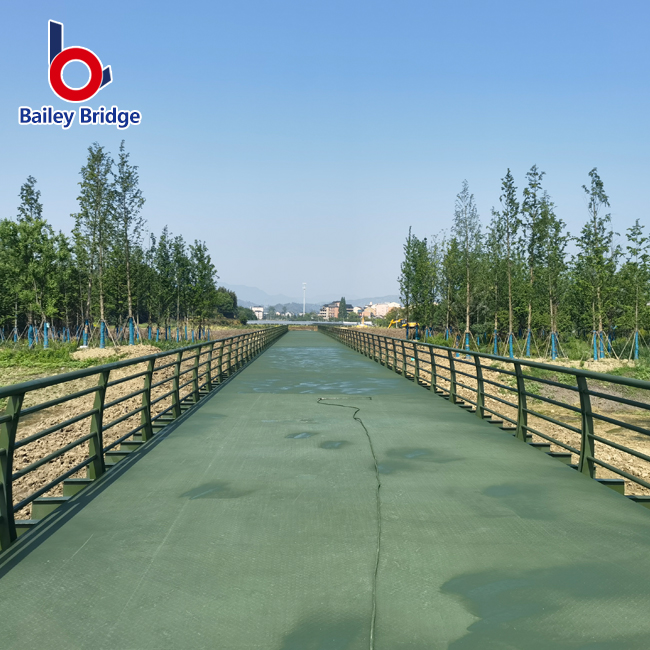
Engineers demand rigorous code compliance before authorizing infrastructure. A modern heavy duty Bailey bridge aligns with strict international design codes. Manufacturers rigorously engineer these structures to meet Eurocode guidelines. They also comply with British Standards like BS5400 and American AASHTO HL-93 criteria. Meeting these standards ensures public safety and structural reliability.
These bridges readily accommodate extreme payloads. You can configure them to handle 40-ton commercial trucks or 120-ton tracked mining excavators. However, maximum capacity relies entirely on your specific span length and truss configuration. A short 20-meter gap easily supports heavy equipment using a simple double-truss layout. If you extend that same gap to 50 meters, the bending moments multiply. You must add more truss rows and reinforcing chords to safely maintain that original 120-ton capacity. Engineers rely on highly detailed load-testing charts to find the exact configuration needed.
Steel grade dictates the ultimate success of your crossing. Modern components require high-yield strength structural steel to perform safely. Factories commonly forge these panels from Q345B, Q390, or Q460 steel grades. These robust alloys absorb immense dynamic stress without cracking. They allow the bridge to flex slightly under heavy vehicle movement and snap back perfectly into place.
Corrosion protection directly impacts project lifespan. Standard structural painting offers a budget-friendly option. It works well for temporary construction access or rapid military deployments where long-term exposure matters less. Hot-dip galvanization serves as the gold standard for long-term or permanent use. The galvanizing process bonds a thick zinc layer directly to the high-yield steel. This prevents rust even in humid, coastal, or highly corrosive environments. Proper galvanization ensures the steel retains its maximum yield strength for decades.
Mining operators and civil contractors face massive logistical hurdles. They often need to move excavators, loaders, and fully loaded dump trucks across unsupported terrain. Rivers and deep ravines frequently block access to profitable ore veins or new dam sites. Standard roads do not exist in these zones.
Deploying this modular system solves the access problem immediately. Rapid assembly minimizes expensive site downtime. Crews launch the bridge quickly, allowing mining trucks to begin hauling weeks ahead of schedule. The impressive shear strength easily handles repetitive, heavy dynamic loads. As huge dump trucks cross daily, the reinforced steel panels absorb the aggressive vibrations without structural fatigue.
Natural disasters aggressively destroy existing infrastructure. Floods cause severe washouts. Earthquakes collapse older concrete and steel bridges. When these vital routes fail, supply chains completely halt. Rescue teams cannot deliver medicine, food, or rebuilding equipment to isolated regions.
Containerized shipping allows for rapid mobilization. Authorities can load bridge components onto standard trucks and dispatch them immediately to the disaster zone. Once on site, specialized teams assemble the structure quickly. They can even erect it without heavy crane access if necessary. Using basic rollers and manual labor, teams push the bridge safely across the flooded gap. This restores critical supply chains in days rather than years.
Developing municipalities often struggle with severe budget constraints. They desperately need reliable river crossings to connect rural farmers to urban markets. Unfortunately, they lack the capital required for custom-engineered, prestressed concrete bridges. Designing and pouring a bespoke bridge strains local tax revenues extensively.
Modular steel systems provide a highly economical long-term solution. Municipalities purchase pre-engineered components rather than paying for unique architectural designs. This standardizes the construction process and eliminates expensive engineering delays. When properly galvanized and maintained, these structures boast lifespans exceeding 50 years. They offer rural communities a robust, permanent highway link without the massive upfront financial burden.
You must acknowledge logistical realities before purchasing bridge components. Fortunately, engineers designed the C200 specifically for standard global freight networks. The panel dimensions and hardware easily pack into standard 20ft or 40ft ISO shipping containers. This standardization keeps international freight costs manageable and predictable.
Estimating container volume helps streamline site deliveries. As a general rule, a single 40ft container holds roughly 12 to 15 linear meters of a standard single-lane bridge. This footprint fluctuates based on your structural configuration. A heavier Triple-Double bridge requires far more steel per meter, significantly reducing the span length you can fit inside one box. Project managers must coordinate closely with suppliers to stage container arrivals correctly at the job site.
Installation methods set this system apart from conventional bridges. You rarely need falsework or scaffolding in the river below. Instead, field crews utilize the cantilever launching method. This ingenious process keeps all workers and equipment safely on dry land.
This method speeds up construction dramatically. It protects the local river ecosystem from heavy machinery and eliminates the dangers of working over open water.
The bridge itself rarely fails. The most common failure point lies in abutment integrity. A high-capacity steel truss is only as strong as the foundation underneath it. If the ground shifts, the bridge will eventually warp or collapse.
You must prioritize extensive site preparation. Do not assume the riverbank can support a loaded 100-ton mining truck. You must mandate comprehensive geotechnical surveys. Engineers test the soil to ensure it possesses the required bearing capacity. The steel base plates exert massive concentrated loads at the four corners of the bridge. If the soil proves too weak, you must construct reinforced concrete abutments or drive deep steel piles to secure the foundation.
Not all modular bridge manufacturers deliver the same quality. Sourcing poorly made components introduces catastrophic safety risks. You must evaluate vendors rigorously using objective engineering criteria.
The Compact 200 Bailey Bridge remains a highly verifiable, scalable solution for extreme heavy-duty access needs. It successfully marries rapid modular deployment with permanent structural integrity. Whether bridging remote mining ravines or reconnecting disaster-struck communities, the pin-jointed design ensures reliable performance. The combination of high-yield steel and cantilever launching mechanics reduces both risk and onsite installation time.
Before requesting formal quotes, you must compile your specific site parameters carefully. Measure your exact gap width. Define your maximum expected vehicle weight and traffic frequency. Determine your lane requirements and assess the local environmental conditions. Presenting this data to a verified manufacturer ensures they engineer the perfect configuration for your project. Rigorous preparation guarantees a safe, durable, and highly efficient bridge deployment.
A: It typically spans up to 60.96m (200ft) for a single clear span without intermediate piers. However, load capacity decreases significantly at maximum lengths. You must utilize heavier, multi-row configurations to maintain structural integrity across wide gaps.
A: Yes, the pin-jointed modular design allows for complete disassembly. You can extract the pins, break the bridge down into its core panels, and deploy it to a completely new site. This makes it highly cost-effective as a reusable temporary asset.
A: Assembly time depends heavily on the overall length, structural configuration, and crew experience. A standard 30-meter single-lane bridge can often be launched in 3 to 7 days. This timeline assumes you have a properly trained crew and minimal heavy machinery.
A: You must exercise extreme caution. While derived from the original design, modern tolerances and steel grades vary by manufacturer. Intermingling parts from different eras or suppliers is structurally risky. Engineers generally advise against mixing components without strict, independent engineering analysis.


