Tel: +86 15262904857 E-mail: overseas@jsbaileybridge.com
- All
- Product Name
- Product Keyword
- Product Model
- Product Summary
- Product Description
- Multi Field Search


Views: 0 Author: Site Editor Publish Time: 2026-07-07 Origin: Site


Road restoration projects often hit a critical roadblock: maintaining traffic flow. Halting movement completely disrupts local economies and strands vulnerable communities. Project managers and civil engineers face a persistent daily dilemma. You must balance the severe financial impacts of complete road closures against the mobilization expenses of temporary infrastructure. An emergency temporary bridge is not universally required for every single road restoration. Your final decision heavily hinges on daily traffic volume and geographical isolation. Regulatory funding avenues and strict safety mandates also play massive roles.
This article provides a clear, evidence-based evaluation framework. We will help you determine exactly when temporary bridging becomes structurally necessary. You will also discover how to assess whether the deployment remains financially viable. By understanding operational triggers, stakeholders can make objective, rapid decisions. Expect to learn the critical differences between structural systems, regulatory guidelines, and potential deployment risks.
Engineers must first evaluate the physical environment before selecting a bridging solution. Not every road repair justifies temporary infrastructure. However, certain operational triggers make deployment absolutely non-negotiable.
Geographic isolation presents the most urgent use case. Evaluate scenarios where a bridge repair effectively traps residents or local commercial operations. Many rural routes or mountain corridors feature zero alternative paths. If you close the primary crossing, communities lose all access to food, water, and medical care.
In these zero-detour environments, deploying temporary bridging becomes mandatory. You cannot simply route traffic twenty miles out of the way. First responders require uninterrupted access to isolated zones. Failure to provide continuous access creates severe liability risks for local municipalities.
Major urban arteries present a different challenge. Address resurfacing or repair projects on major highways where halting traffic causes unacceptable bottlenecks. A detour might technically exist. However, pushing highway volumes onto residential streets creates massive logistical failures. Localized economic damage accrues rapidly when freight corridors stall.
Engineers must measure the acceptable delay threshold. If rerouting adds two hours to a commercial trucking route, indirect costs explode. Maintaining high-volume traffic continuity prevents localized gridlock. Temporary bridging allows construction crews to work underneath while keeping the local economy moving above.
Natural disasters require immediate action. Outline the threshold for deployment following washouts, extreme floods, or sudden structural collapses. When critical infrastructure fails without warning, immediate supply chain access is heavily compromised. Relief efforts depend entirely on reliable road networks.
In disaster recovery scenarios, speed dictates survival. Communities need rapid deployment of temporary structures to restore basic services. Power grid repair crews and emergency medical personnel cannot wait for a permanent bridge rebuild. The threshold for action is crossed the moment a primary route suffers catastrophic failure.
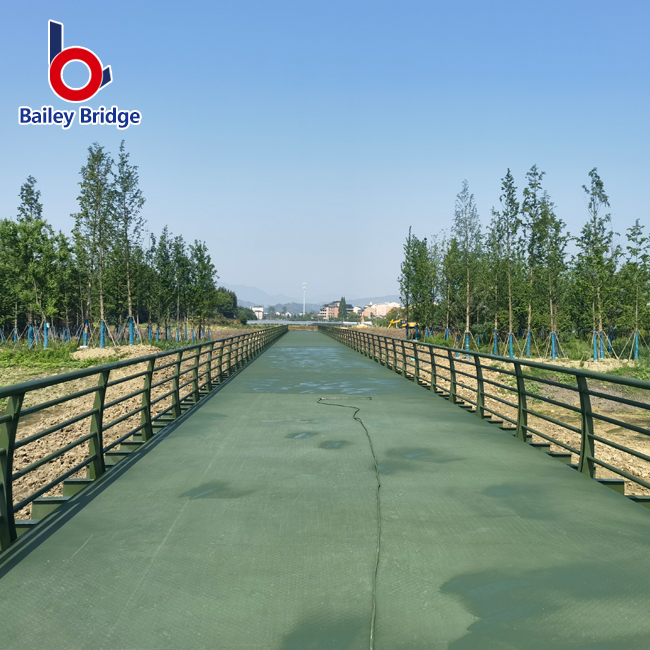
Selecting the correct hardware depends entirely on project timelines and load requirements. Two primary categories dominate the temporary infrastructure market. You must understand the distinct capabilities of each system to ensure proper deployment.
When engineering requirements demand heavy-duty performance, you need robust options. When evaluating an emergency temporary bridge,steel bridge structure systems consistently deliver superior results. These units handle extreme weights and extended project timelines.
Short-term projects often benefit from highly mobile alternatives. These solutions prioritize speed over long-term permanence. They shine in rapid-repair environments.
| Feature Category | Modular Steel Structures | Mobile / Vehicle-Launched |
|---|---|---|
| Load Capacity | HL-93 Highway Standard | Light to Medium Commercial |
| Deployment Speed | Days to Weeks | Hours to Days |
| Maximum Span | Highly Customizable (Long) | Restricted (Short) |
| Project Duration | Months to Years | Days to Weeks |
| Foundation Needs | Engineered Abutments | Minimal / Temporary Pads |
Installing temporary infrastructure involves navigating complex bureaucratic requirements. Federal and local agencies enforce strict safety guidelines. Ignoring these regulations jeopardizes project funding and introduces severe legal liabilities.
Federal bodies like the FHWA strictly differentiate temporary emergency relief installations from permanent infrastructure. You must carefully detail the criteria used by these agencies. Emergency classifications often bypass standard competitive bidding rules. This greatly impacts project funding access and overall approval speed.
However, temporary installations face strict time limits. If a municipality leaves an emergency structure in place too long, funding agencies might revoke disaster relief grants. Decision-makers must align perfectly with FHWA guidelines to protect their budgets.
Safety remains the ultimate priority during deployment. Analyze the strict safety requirements for temporary installations. University transportation centers and government manuals outline exact specifications. You must implement specific approach speeds based on bridge geometry.
Barrier requirements prevent vehicles from leaving the elevated decking. Planners must also integrate safe pedestrian and cyclist considerations. If the original route supported foot traffic, the temporary solution must legally accommodate those same vulnerable users safely.
Best Practice: Always consult the latest Manual on Uniform Traffic Control Devices (MUTCD) before designing approach zones. Proper signage dramatically reduces rear-end collisions near temporary bridges.
Common Mistake: Failing to adjust speed limits well in advance of the bridge transition point. Sudden speed drops on highway approaches frequently cause dangerous traffic shockwaves.
Waterway crossings trigger intense environmental scrutiny. Discuss the permitting exemptions often granted during officially declared emergencies. Governors can issue executive orders to suspend lengthy ecological reviews. This allows immediate bridge placement over sensitive rivers.
Conversely, non-emergency temporary placements require stringent environmental impact reviews. Agencies will monitor potential debris shedding, soil erosion, and fish migration impacts. Always verify your emergency status in writing before skipping standard environmental permit applications.
Financial viability often dictates the final engineering choice. Planners must calculate both direct expenditures and indirect community burdens. A balanced financial framework justifies the upfront deployment expenses.
Break down the highly tangible costs associated with temporary infrastructure. First, you must fund the initial geotechnical engineering and site design. Next, planners must evaluate leasing versus purchasing the physical asset. Leasing usually makes sense for timelines under two years.
Heavy mobilization costs include freight transport and crane rentals. Finally, budget for the eventual teardown and site restoration. These direct costs represent significant upfront capital requirements for any municipality.
To justify the direct costs, provide a framework for calculating the cost of not installing a bridge. Indirect costs often dwarf the price of steel.
When does temporary bridging make financial sense? You must determine the exact point where the daily cost of a detour eclipses the total mobilization cost. If a detour costs the local economy $50,000 per day in lost productivity, a $1 million bridge pays for itself in twenty days. This shortlisting logic empowers engineers to quickly defend their funding requests to skeptical oversight boards.
Theoretical planning eventually meets physical reality on the construction site. Project managers must anticipate deployment friction. Ignoring site-specific engineering realities guarantees project delays and budget overruns.
Industry marketing often promotes a myth of instant installation. Dispel this notion immediately. Detail the harsh engineering realities of soil stabilization. Crews must heavily compact the earth and pour concrete pads.
Temporary abutment construction requires massive preparation before any steel bridge structure can be launched. If the riverbank soil lacks shear strength, the temporary abutments will sink under heavy commercial loads. Do not rush the geotechnical preparation phase.
Select your installation partners using strict criteria. Vetting local contractors prevents catastrophic launch failures. Ask specific questions during the bidding process.
Choosing a partner who only delivers materials leaves your local crews struggling with unfamiliar assembly protocols.
Temporary structures require constant vigilance. Highlight the specific inspection frequencies required by federal law. Structures carrying continuous dynamic loads experience rapid bolt loosening.
Crews must implement strict tightening protocols on a weekly or monthly basis. You must inspect decking panels for wear and monitor the abutments for slow settling. Neglecting routine maintenance on a temporary structure invites sudden, catastrophic failure under heavy traffic.
Deciding to deploy temporary infrastructure requires strict analytical discipline. The final decision matrix involves four distinct steps. First, confirm the operational trigger, such as geographic isolation or severe traffic bottlenecks. Second, accurately calculate the indirect detour costs against mobilization expenses. Third, verify all compliance frameworks with federal and local agencies. Finally, assess your site readiness and engineering capabilities.
Project planners should take immediate, action-oriented next steps. Commission a comprehensive geotechnical site survey today to understand your soil conditions. Next, engage directly with a modular bridge engineer to run a localized cost-benefit analysis. Proactive evaluation prevents chaotic decision-making when an unexpected road closure suddenly threatens your community.
A: Delivery times vary significantly from actual assembly times. Materials might arrive on-site within days during a declared emergency. However, site preparation demands substantial effort. Crews must stabilize the soil and construct engineered abutments first. Actual assembly and launching usually take a few days to a few weeks. Timelines strictly depend on span length and site readiness.
A: Yes, modular systems easily handle heavy commercial freight. Modern temporary structures are designed to meet standard HL-93 highway load ratings. However, the bridging hardware is only half the equation. You must build properly engineered abutments to safely transfer those massive dynamic loads into the ground.
A: The decision relies on a clear breakeven timeline. Leasing usually makes financial sense if the bridge will remain in place for under 18 to 24 months. Purchasing becomes cost-effective for longer-term projects. Municipalities also buy them outright if they intend to stockpile the assets for future local disaster inventory.
A: It depends heavily on the project context. During officially declared emergencies, executive orders frequently suspend standard environmental impact reviews to ensure rapid deployment. However, standard pre-planned restorations do not receive these exemptions. Non-emergency temporary bridges face the exact same stringent environmental permitting processes as permanent infrastructure.


