Tel: +86 15262904857 E-mail: overseas@jsbaileybridge.com
- All
- Product Name
- Product Keyword
- Product Model
- Product Summary
- Product Description
- Multi Field Search


Views: 0 Author: Site Editor Publish Time: 2026-06-29 Origin: Site


Civil engineering projects often face a difficult balancing act. Teams must deploy temporary access routes quickly while handling massive equipment loads. Strict budget constraints also dictate hard limits on custom infrastructure. How do you cross a washed-out river without spending months on structural design? You need a pre-engineered, modular solution.
The Compact 321 Bailey Bridge serves as an industry standard for these exact scenarios. It bypasses compromised infrastructure effortlessly. It crosses tough geographical obstacles with minimal site preparation. Procurement managers and project engineers rely on it heavily worldwide.
This article provides a clear, objective framework. You will learn how to evaluate this structural asset properly. We will cover its configurations, core use cases, and site assembly risks. By the end, you can decide if it aligns perfectly with your temporary access requirements.
Modern infrastructure demands predictable results. Custom temporary bridges often bring high lead times. They also carry unpredictable engineering costs. Standardized truss systems offer a proven, mathematical alternative.
The 321 designation refers to its standard panel dimensions. Each panel measures roughly 3 meters long by 1.5 meters high. These components evolved significantly from their original wartime designs. Today, manufacturers build them using commercial-grade, high-tensile steel. This upgrades their yield strength tremendously. It allows modern contractors to push heavy commercial loads safely.
Prefabricated systems deliver absolute predictability. Engineers know the exact load ratings beforehand. You skip the lengthy structural design phase entirely. A custom-welded bridge requires specialized fabrication. It demands unique blueprints and extensive material testing. Standardized components bypass these hurdles. You simply select the right configuration from an established engineering table.
Component efficiency acts as a major logistical advantage. The modular pin-and-panel system breaks down into manageable parts. You can pack an entire structure into standard ISO shipping containers. This minimizes ocean and overland freight volume. It also drastically simplifies your site logistics. Standard flatbed trucks deliver parts directly to constrained locations. You do not need expensive highway escorts for oversized loads.
Common Mistake: Do not mix components from different manufacturers. Even slight manufacturing tolerances can cause severe pin alignment issues during assembly.
Different industries leverage these structures to solve unique logistical hurdles. They bridge gaps where traditional roadbuilding fails.
Heavy civil projects rely on them daily. Contractors transport massive crawler cranes across waterways. They move fully loaded dump trucks over sensitive ecological zones. You can also install them over existing active highways. This keeps local civilian traffic moving safely while your crews work below.
Resource extraction faces extreme geographical isolation. Logging sites and mining camps often sit in remote environments. Heavy equipment cannot safely ford deep rivers or mudslides. Here, a portable Bailey bridge becomes an absolute necessity. It handles off-road articulated dumpers effortlessly. You assemble it quickly to keep supply chains open.
Emergency management demands a rapid response. Severe floods frequently wash out municipal bridges. Teams use modular steel structures to restore critical access quickly. They ensure strict civilian traffic load compliance. Ambulances, fire trucks, and supply convoys can cross within days of a disaster.
These structures are highly versatile tools. However, you should view them primarily as temporary to semi-permanent solutions. They perform optimally for 1 to 10 years. Permanent highway infrastructure requires different fatigue lifecycle considerations. Constant, heavy public traffic will eventually fatigue the connection pins over decades.
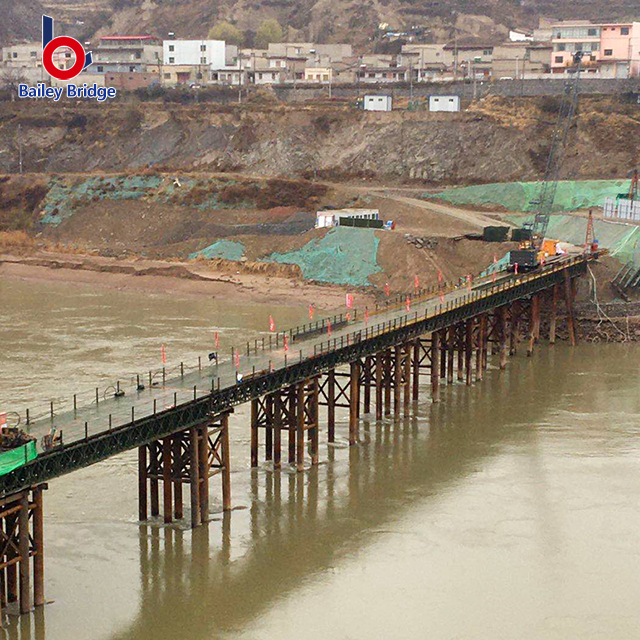
You cannot guess structural capacities. Project engineers scale the capacity by combining truss panels mathematically. You adapt the configuration to match the required span and target payload.
Engineers increase strength by adding rows and tiers. Standard highway loads require lighter setups. Heavy off-road dumpers need robust, multi-layered reinforcement. You connect panels side-by-side (rows) and stack them vertically (tiers).
| Truss Configuration | Row/Tier Setup | Typical Payload Target | Optimal Span Range |
|---|---|---|---|
| Single-Row / Single-Tier (SS) | 1 Row, 1 Level | Light vehicles, pedestrians | Up to 24 meters |
| Double-Row / Single-Tier (DS) | 2 Rows, 1 Level | Standard highway trucks | Up to 30 meters |
| Double-Row / Double-Tier (DD) | 2 Rows, 2 Levels | Heavy construction equipment | Up to 45 meters |
| Triple-Row / Double-Tier (TD) | 3 Rows, 2 Levels | Extreme off-road haulers | Up to 60 meters |
Span limitations dictate your overall design choices. A strict inverse relationship exists between span length and load capacity. Longer spans handle lighter maximum loads before intermediate piers become necessary. Realistic parameters ensure site safety. Always consult certified span-load tables before finalizing your design. Pushing a span beyond its rated limit invites catastrophic failure.
Decking materials require careful evaluation based on your expected traffic volume. You must choose between two primary systems:
Launching a modular bridge involves precise physics and careful execution. You must control the center of gravity at all times.
The cantilever launch method remains the standard deployment procedure. It completely removes the need for in-water falsework. Crews push the structure across the gap from one side. This protects sensitive riverbeds.
Here is the standard launch sequence:
Failure happens when teams ignore site realities. You must manage several critical risks during the build phase.
Abutment Stability: You must verify the geotechnical conditions. The steel is only as strong as the ground supporting its base plates. Soft soil will cause immediate settlement under load. Always mandate formal soil bearing assessments before construction begins.
Roller Settlement: Unequal settlement during the push phase is incredibly dangerous. It can cause structural binding. In severe cases, it leads to catastrophic tipping. Ensure your roller foundations remain perfectly level throughout the launch.
Pin & Tolerance Wear: Always inspect connection pins. This matters heavily for leased or reused inventory. Worn pins introduce unsafe sag into the span. Use only certified, non-fatigued pins to secure the truss panels.
Best Practice: Keep a dedicated safety officer watching the tail counterweight. If the push exceeds the counterweight balance, the structure will plunge into the gap.
Procurement requires careful financial logic and rigid vendor vetting. You must align your acquisition strategy with your project pipeline.
You must decide whether to lease or purchase the equipment. Leasing makes perfect sense for one-off, short-duration projects. If your site needs access for under 18 months, rent the hardware. You return the steel when the job finishes. Purchasing becomes highly logical if your firm maintains a steady pipeline of remote projects. Owning the asset allows rapid deployment for future contract bids.
Quality compliance protects your project and your personnel. You must demand strict documentation from manufacturers. Do not accept hardware without verifiable proof of origin. Request mill test certificates for all raw steel materials. Look for certified grades like Q345 or Q355 high-tensile steel. Insist on ISO welding certifications from the factory floor.
Furthermore, require localized load-rating calculations. A registered structural engineer must sign and stamp these documents. This proves the hardware can handle your specific excavators.
Logistics profiles dictate your actual landed budget. Calculate every freight element carefully before signing contracts. Factor in flatbed transport from the port directly to the installation site. You must also budget for skilled supervision.
Having a manufacturer representative on-site during assembly prevents costly mistakes. They ensure your crew follows the correct build sequence. Paying for an expert supervisor always costs less than repairing a dropped bridge.
Let us wrap up the core findings for your access strategy. The modular approach delivers unmatched reliability for remote sites.
A: Assembly time depends heavily on the span, configuration, and crew experience. A trained crew of six to eight workers can typically assemble and launch a standard 30-meter single-tier structure in three to five days. Complex, multi-row configurations spanning longer distances may require up to two weeks. Using an experienced on-site supervisor drastically reduces this timeline.
A: Yes, it can support massive industrial loads. Engineers adapt the structure by adding extra rows and tiers. A triple-row, double-tier configuration handles extreme off-road haulers and heavy crawler cranes easily. However, you must ensure the concrete or steel abutments can absorb these massive transfer forces safely.
A: Routine maintenance is highly straightforward but absolutely critical. Crews must regularly check the torque on all transom bolts and sway braces. Inspectors should verify that all panel connection pins remain fully secured with safety clips. In marine or corrosive environments, you must routinely inspect the galvanization or paint for rust.
A: Bailey bridges are strictly linear structures and cannot be curved. All turning radiuses must be handled on the approach roads. You can elevate the structure on a gradient, but it must stay within strict longitudinal limits. Steep gradients reduce vehicle traction and alter the load distribution on the abutments.


