Tel: +86 15262904857 E-mail: overseas@jsbaileybridge.com
- All
- Product Name
- Product Keyword
- Product Model
- Product Summary
- Product Description
- Multi Field Search


 |


| Quantity: | |
|---|---|
HD200 Bailey Bridge
BAILEY
Technological Iteration: Achieving Performance Leaps Through Heritage and Innovation
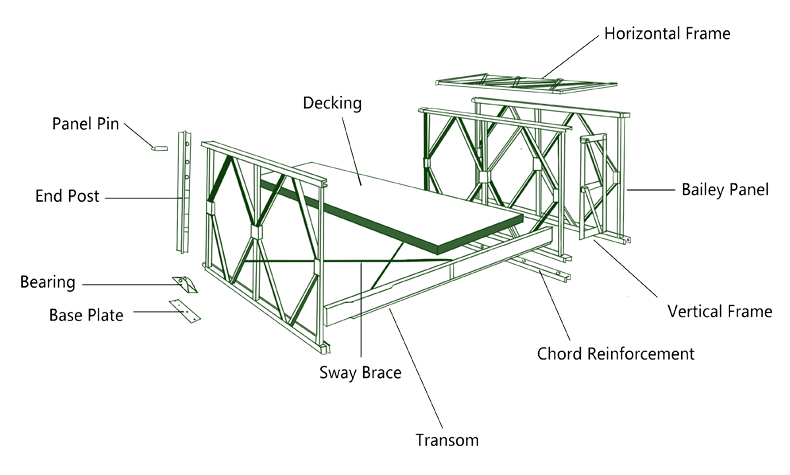
The reconstruction of Bailey bridges thrives on "Technological Iteration." While traditional designs offer flexibility, they often fall short of modern standards for corrosion resistance, load capacity, and complex site adaptation. Successful reconstruction is a practice of "preserving the essence while innovating." Jiangsu Bailey's intelligent manufacturing is a prime example: by upgrading truss production to robotic laser cutting and automated welding, we maintain precision at the millimeter level. This retains the Type 321's modular core while boosting load capacity to 90 tons for heavy engineering vehicles. In Zelihovo, Poland, engineers used finite element simulation to extend the central span of a foldable Bailey bridge by 4 meters, transforming it into a bascule (lift) bridge—a perfect synergy of industrial aesthetics and modern navigation. In emergencies, innovation is vital: China-aided bridges in the Philippines featured anti-salt spray coatings and seismic connectors, allowing assembly within 3-5 days and securing the "Golden 72 Hours" for rescue operations.
Functional Revitalization: Extending Life Value Through Scenario Expansion
The vitality of the Bailey bridge has always transcended military use. Modern reconstruction maximizes its modular strengths to achieve "multi-purpose" utility:
The "Lifeline" in Emergencies: After the Luding earthquake, a 60m Type 321 bridge was erected in just 17 days. Following New Zealand’s cyclone, Bailey bridges became essential hubs for traffic recovery.
The "Efficient Supporting Role" in Infrastructure: A 1,174m Bailey bypass near Gdańsk, Poland, served as a temporary dual-lane corridor during permanent bridge construction. Its reusability significantly slashed project costs.
The "Spiritual Carrier" Through Cross-Border Application: The Bailey Bridge Museum in the UK showcases evolution from WWII tank bridges to modern systems. Some decommissioned structures have even become "industrial-style" landscape trails in urban parks. This revitalization transforms Bailey bridges from "specific tools" into "diverse assets."
From the restoration of WWII prototypes to China’s intelligent upgrades, the reconstruction of Bailey bridges balances inheritance with innovation. By upholding the "modular and easy-to-assemble" military DNA while adapting to "intelligent and high-load" trends, we ensure that this military-inspired ingenuity continues to span rivers and generations.