Tel: +86 15262904857 E-mail: overseas@jsbaileybridge.com
- All
- Product Name
- Product Keyword
- Product Model
- Product Summary
- Product Description
- Multi Field Search


A Bailey Bridge is a modular, portable, and temporary bridge system that was designed to be easily assembled in challenging terrains and environments. Named after its inventor, British civil engineer Sir Donald Bailey, the Bailey Bridge was initially created during World War II to provide quick, reliable crossings for military forces. Over the decades, its design has evolved into a versatile solution widely used for both military and civilian purposes.
In this article, we will delve into the features, advantages, and applications of the Bailey Bridge, explore its historical significance, and discuss why it remains one of the most effective bridge systems for emergency and military use.
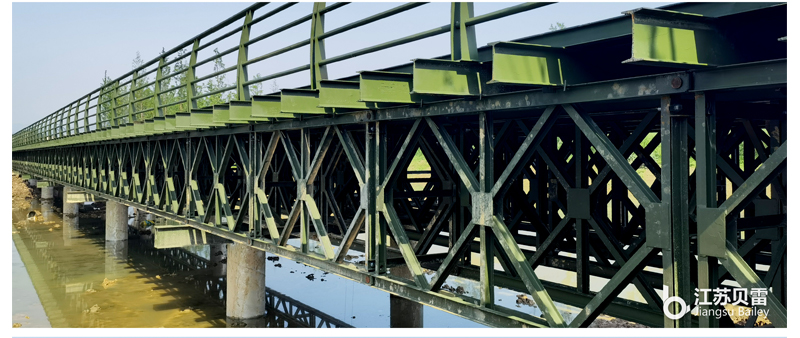
The Bailey Bridge was first introduced in 1940 by Sir Donald Bailey, a British engineer working for the British Army. During World War II, there was an urgent need for a quick and efficient solution to allow military vehicles to cross rivers and other difficult terrain. The Bailey Bridge, designed to be easily assembled and disassembled, proved to be the perfect solution. Its portability allowed military units to construct and dismantle bridges in record time.
The bridge system was revolutionary for its time because it could be built by a small team of soldiers without the need for specialized skills. It consisted of prefabricated steel panels, which could be transported in parts and assembled on-site. This simplicity and efficiency made it invaluable for military operations, particularly in regions where traditional bridge construction would have been impractical or too time-consuming.
A Bailey Bridge is a modular structure, meaning it is made up of pre-engineered components that are assembled on-site. The basic components of a Bailey Bridge include:
Panels – The main structural elements of the bridge. Each panel consists of steel trusses arranged in a grid pattern. The panels interlock to form the deck of the bridge.
Bearers – These support the weight of the bridge and are placed perpendicular to the panels.
Transoms – These components help to spread the load across the structure and connect the panels to the bearers.
Decking – The surface that provides a pathway for vehicles and pedestrians.
The beauty of the Bailey Bridge lies in its flexibility. Its modular design allows for a variety of configurations, making it suitable for different load capacities and span lengths. Additionally, the bridge can be assembled in a matter of hours or days, depending on the scale, making it ideal for emergency use or areas where traditional construction would take too long.
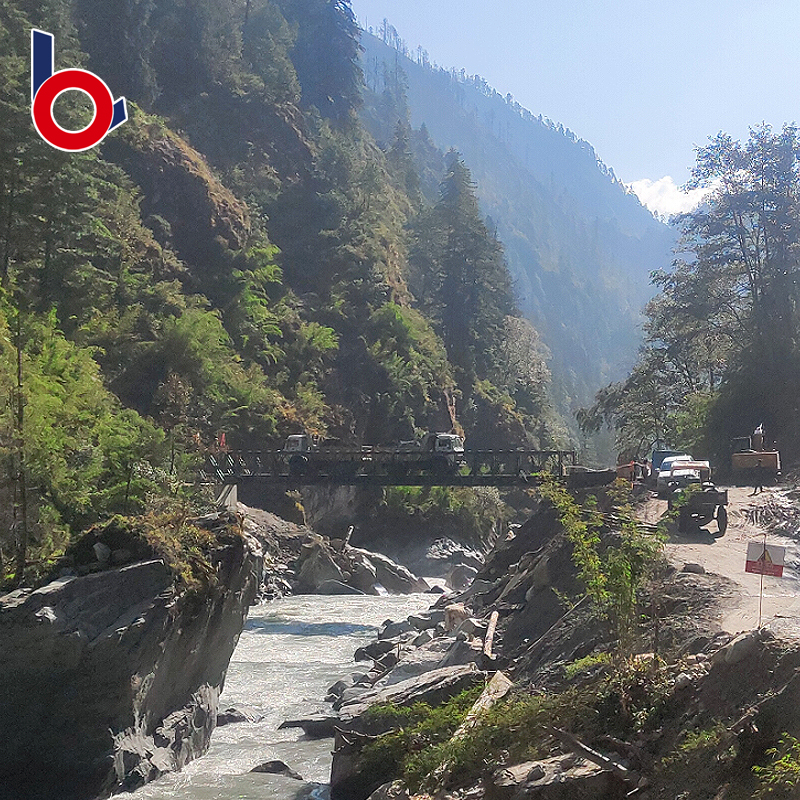
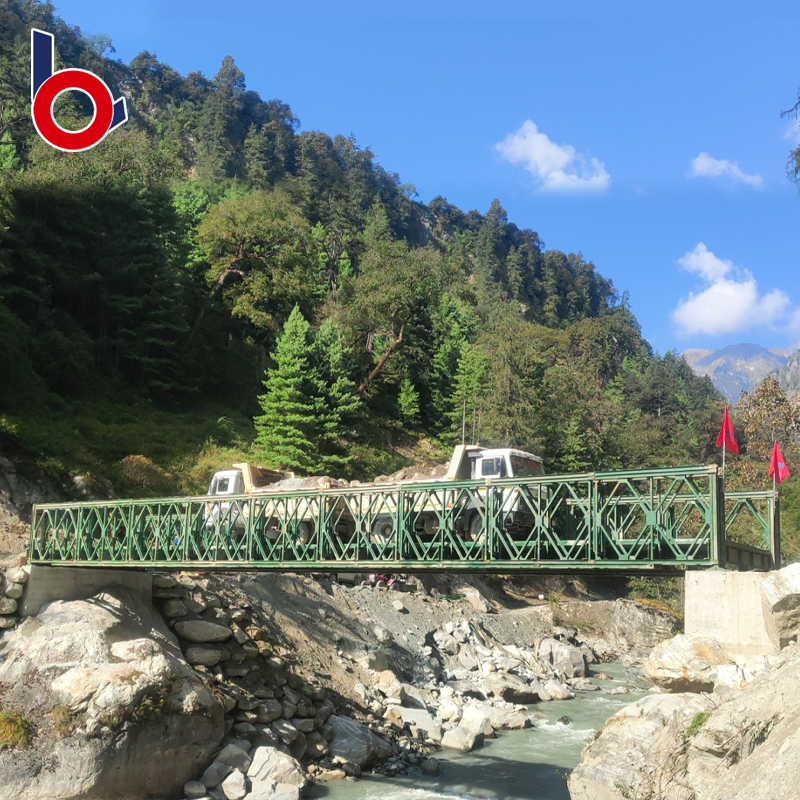

One of the most significant advantages of the Bailey Bridge is its speed of construction. Unlike traditional bridges that require extensive labor and time to build, a Bailey Bridge can be erected within hours, depending on the span and terrain. This rapid deployment makes it ideal for emergency response situations, military operations, or any instance where a bridge is needed quickly.
The modular design of the Bailey Bridge allows it to be customized based on the specific needs of a given location. The components can be easily reconfigured to suit different spans, widths, and load capacities. Whether it is needed for a pedestrian crossing, a light vehicle passage, or a bridge capable of handling heavy military trucks, the Bailey Bridge can be adjusted to meet the demands.
Another key feature of the Bailey Bridge is its portability. The individual components are lightweight enough to be transported by road, rail, or air, making it highly adaptable to various logistics. This characteristic is particularly important in military applications where transport infrastructure may be limited or non-existent.
Building traditional bridges often involves significant investment in materials, labor, and time. In contrast, the Bailey Bridge offers a cost-effective alternative, particularly for temporary or emergency crossings. It eliminates the need for heavy construction equipment and can be assembled with minimal manpower, significantly reducing costs.
Despite its relatively simple design, the Bailey Bridge is exceptionally strong and durable. Modern versions of the bridge are constructed using high-quality steel, making them resistant to environmental conditions like rain, wind, and snow. The bridges are also designed to withstand heavy loads, making them suitable for a variety of applications.
The Bailey Bridge was initially developed for military purposes, and it remains one of the most important tools in military engineering. Its rapid assembly and portability make it ideal for battlefield situations where a reliable crossing is needed immediately. It has been used in numerous military conflicts, including World War II, the Korean War, and the Gulf War.
In disaster-stricken areas where infrastructure has been damaged or destroyed, the Bailey Bridge can provide a quick solution for reconnecting communities. Whether due to flooding, earthquakes, or other natural disasters, the bridge’s modular components can be easily assembled to restore access to vital services, including healthcare, food, and transportation.
While the Bailey Bridge was originally designed for military use, its versatility has made it a popular choice for civil infrastructure projects. It is commonly used in remote areas where conventional construction is not feasible, such as in mountainous regions or where access to materials and labor is limited. The bridge can also serve as a temporary structure while a more permanent bridge is being built.
In situations where a bridge is required for only a short period, the Bailey Bridge provides a perfect solution. Its ease of assembly and disassembly makes it an ideal choice for temporary crossings, such as for special events or construction projects that require short-term access over rivers, roads, or other obstacles.
Over the years, the design of the Bailey Bridge has undergone several improvements to make it even more effective and adaptable to modern needs. Modern versions use advanced steel alloys and improved manufacturing techniques to enhance the bridge’s strength, durability, and longevity.
Some versions now incorporate pre-stressed concrete to increase load-bearing capacity, while others feature modular components that can be used in a wider range of configurations. Additionally, advancements in transportation logistics have made it even easier to move and deploy these bridges to remote or difficult-to-reach areas.
The Bailey Bridge is a remarkable engineering achievement that has stood the test of time. From its origins in World War II to its modern applications in military, civilian, and emergency contexts, the Bailey Bridge remains one of the most effective solutions for overcoming the challenges of transportation in difficult terrains.
Jiangsu Bailey Steel Bridge Co., LTD continues this legacy with the production of high-quality Bailey Bridges that meet both military and civilian needs. With over 18 years of experience, the company integrates advanced manufacturing processes and rigorous quality control to ensure the bridges are built to last, providing a reliable and cost-effective solution for temporary and permanent crossings.
What are the key components of a Bailey Bridge?
A Bailey Bridge consists of steel panels, bearers, transoms, and decking. These modular components are easily assembled on-site to form a complete bridge structure.
How long does it take to build a Bailey Bridge?
The construction time for a Bailey Bridge can vary, but it typically takes just a few hours to a few days depending on the span and terrain.
Can a Bailey Bridge be used for heavy traffic?
Yes, modern Bailey Bridges are designed to handle heavy loads, including military vehicles and trucks, making them suitable for a variety of applications.
Where is a Bailey Bridge typically used?
Bailey Bridges are commonly used in military operations, emergency relief efforts, civil infrastructure projects, and temporary crossings in areas with challenging terrain.
How durable are Bailey Bridges?
Bailey Bridges are highly durable and can withstand various environmental conditions, including extreme weather and heavy traffic. They are built to last for many years, even in harsh conditions.


