Tel: +86 15262904857 E-mail: overseas@jsbaileybridge.com
- All
- Product Name
- Product Keyword
- Product Model
- Product Summary
- Product Description
- Multi Field Search


Views: 0 Author: Site Editor Publish Time: 2026-01-26 Origin: Site


In today’s rapidly evolving construction landscape, the need for fast, efficient, and cost-effective infrastructure solutions has never been greater. Modular Bailey Bridges stand out as a game-changing option for reducing both construction time and costs. Their modular design, portability, and ease of installation make them ideal for projects in remote locations, emergency scenarios, and long-term infrastructure solutions.
This article will explore in detail how modular Bailey Bridges significantly reduce construction time and cost compared to traditional bridge-building methods. We will look at the components that contribute to their efficiency, how they save on labor, material, and equipment costs, and how they continue to provide long-term savings and environmental benefits.
A modular Bailey Bridge is a pre-engineered, portable, and easy-to-assemble bridge system. The core concept behind Bailey Bridges is their modularity—each bridge consists of standardized components that are fabricated off-site and then quickly assembled at the construction location. These components are designed to interlock and create a robust, stable structure capable of supporting heavy loads.
The main components of a Bailey Bridge include:
Panels: These are the structural units that form the framework of the bridge. Made from steel or aluminum, they interlock to form a secure, durable bridge.
Bearers: Vertical supports that are placed under the panels to distribute weight evenly.
Transoms: Horizontal beams that hold the panels together and support the bridge deck.
Decking: The surface that vehicles or pedestrians use to cross the bridge, which can be customized depending on the traffic load.
This design offers the flexibility to create bridges that can range in size and capacity, from small pedestrian bridges to large vehicular crossings.
Modular Bailey Bridges are easy to assemble thanks to their pre-fabricated, standardized components. The process begins with transporting the parts to the site. Once on-site, the panels are placed and secured, followed by the installation of the bearers and transoms. This process can be done with minimal machinery and labor, reducing the time and costs involved in traditional bridge construction. The entire process typically takes a fraction of the time required for traditional bridge-building methods.
One of the most significant factors that reduce construction time is the pre-fabrication of Bailey Bridge components. Unlike traditional bridges that are built on-site using raw materials, Bailey Bridges are manufactured off-site in a controlled environment. The panels, bearers, and other components are fabricated and tested for quality and durability before being transported to the construction site. This eliminates the need for extensive on-site manufacturing processes.
Pre-fabrication ensures that each component is ready for quick assembly once it arrives at the site, significantly reducing the time spent on site preparation and construction.
Construction Step | Bailey Bridge | Traditional Bridge |
Site Preparation | Minimal site preparation required | Extensive site work and foundation needed |
Assembly/Construction Time | Days to assemble, depending on size | Weeks to months, depending on complexity |
Material Procurement | Pre-fabricated components available | Requires on-site raw material procurement |
Machinery Requirements | Minimal machinery needed for assembly | Heavy machinery required for construction |
The installation of modular Bailey Bridges is faster than traditional bridge construction methods because of the simplified assembly process. Once the parts arrive at the site, the assembly typically involves aligning and securing the pre-fabricated panels, bearers, and transoms into place. The design of these components ensures they can easily be interlocked, allowing for rapid construction with minimal on-site adjustments.
This speed of installation is crucial in emergency situations, such as natural disasters or military operations, where infrastructure needs to be put in place quickly.
Bailey Bridges require minimal site preparation compared to traditional bridges. Traditional bridge construction often involves significant groundwork, such as excavation, foundation work, and site clearing, all of which can extend the project timeline. In contrast, Bailey Bridges can be installed with limited disruption to the surrounding area. The foundation required is often a simple, level surface, reducing the need for costly and time-consuming excavation.
By minimizing the complexity of site preparation, Bailey Bridges save valuable time and reduce overall project costs.
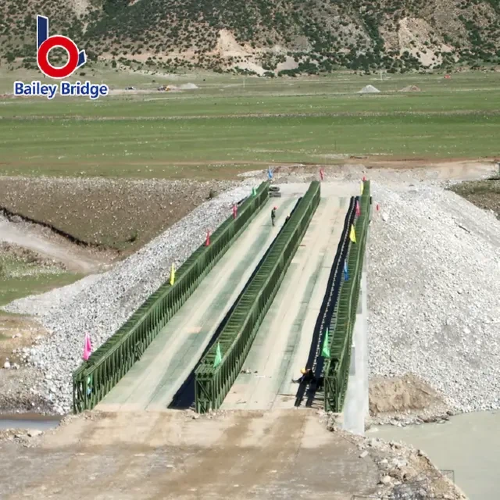
The material costs for traditional bridges can be significant, as they involve the procurement of large quantities of raw materials that must be transported and stored on-site. Modular Bailey Bridges, on the other hand, use pre-fabricated components that are standardized, reducing the amount of material wasted. Since the components are produced off-site and then transported in bulk, there is also less need for on-site storage, further cutting down on logistical expenses.
Additionally, the lightweight nature of the components means that fewer resources are needed to transport them, which reduces transportation costs.
Labor is one of the most significant expenses in traditional bridge construction. The labor costs for preparing the site, mixing materials, and erecting a traditional bridge can be substantial, especially in remote areas where skilled workers may be scarce.
In contrast, the assembly of Bailey Bridges requires fewer workers and significantly less time. The pre-fabrication of components means that the assembly process is straightforward and doesn’t require specialized skills, allowing for local labor to perform the work. This reduction in labor requirements leads to lower overall labor costs, which is especially important for projects in cost-sensitive or remote locations.
Traditional bridge construction requires heavy machinery, such as cranes, bulldozers, and mixers, which are expensive to transport and operate. These machines add to the overall cost of the project and can delay construction if not readily available.
Bailey Bridges are designed to be assembled with minimal machinery. In many cases, cranes and heavy transport vehicles are not necessary. The components are lightweight and can be handled with basic tools or smaller machinery, resulting in lower equipment rental and transportation costs. This is particularly valuable in remote locations where access to such equipment may be limited.
Once installed, modular Bailey Bridges are designed for longevity with minimal maintenance requirements. The materials used, such as galvanized steel and aluminum, are resistant to corrosion and wear, reducing the need for regular maintenance and repairs.
Traditional bridges, by comparison, require frequent inspections and maintenance to ensure their safety and structural integrity, especially in harsh environments. The low maintenance requirements of Bailey Bridges provide significant long-term cost savings, particularly in remote or off-grid areas where maintenance resources are limited.
Another long-term cost-saving feature of modular Bailey Bridges is their flexibility. Due to their modular nature, Bailey Bridges can be easily modified, expanded, or relocated if needed. This makes them ideal for temporary projects, such as emergency crossings, where the infrastructure might need to be moved or adjusted once the immediate needs are met.
Additionally, the components of a Bailey Bridge can be reused in other projects, reducing the cost of constructing new bridges from scratch. This adaptability makes Bailey Bridges a sustainable and cost-efficient option for long-term infrastructure solutions.
Traditional bridge construction often results in significant environmental disruption, such as deforestation, excavation, and waste generation. Bailey Bridges, however, are designed to minimize the impact on the surrounding environment. Their lightweight components require less site clearing, and the modular nature of the bridge reduces the need for extensive excavation.
By limiting the environmental impact of construction, Bailey Bridges help reduce the overall carbon footprint of infrastructure projects, which is increasingly important for sustainable development goals.
Bailey Bridges maximize resource utilization by using standardized components that are easily transportable and scalable. This efficiency ensures that labor, materials, and time are used optimally, resulting in cost savings throughout the project lifecycle.
The efficiency of Bailey Bridges extends to the supply chain as well. Since the components are pre-fabricated and tested off-site, there is less chance of delays due to faulty or inadequate materials. This contributes to a smoother, more cost-effective construction process.
Modular Bailey Bridges offer significant advantages in reducing both construction time and costs. With their pre-fabricated design, rapid assembly process, and minimal site preparation, they provide an efficient alternative to traditional bridge-building methods. Whether utilized for temporary crossings or long-term infrastructure, these bridges deliver cost-effective, sustainable, and high-performing solutions.
By cutting down on material, labor, and equipment costs, Bailey Bridges not only save money during the construction phase but also provide long-term value through their durability and low maintenance requirements. Furthermore, their flexibility, scalability, and minimal environmental impact make them a responsible choice for modern infrastructure projects.
At Jiangsu Bailey Steel Bridge Co., LTD., we specialize in providing high-quality modular Bailey Bridge solutions that cater to your specific project needs. Whether you're planning an urgent temporary crossing or a permanent bridge, our innovative systems offer the efficiency and reliability you need. Contact us today to learn more about how we can help bring your infrastructure project to life with modular Bailey Bridges.
What is a modular Bailey Bridge?
A modular Bailey Bridge is a bridge system made up of pre-fabricated components that can be easily assembled on-site. Its modular design allows for customization and quick installation, making it ideal for a variety of infrastructure projects.
How does the pre-fabrication of modular Bailey Bridges save time?
Pre-fabrication allows the components to be manufactured in a controlled environment and transported to the site, reducing on-site construction time and eliminating the need for raw material processing.
What factors contribute to the reduced cost of building a Bailey Bridge?
The use of pre-fabricated, standardized components, reduced labor requirements, and minimal machinery needed for assembly contribute to the reduced cost of building a Bailey Bridge compared to traditional bridges.
Are modular Bailey Bridges environmentally friendly?
Yes, Bailey Bridges minimize environmental disruption during installation, use sustainable materials, and are designed to be reused, making them an eco-friendly option for infrastructure projects.
Can modular Bailey Bridges be used for large infrastructure projects?
Yes, Bailey Bridges are scalable and can be adapted for both small and large projects. Their modular nature allows for easy customization based on the needs of the project.


